
Binance Hack: 99.5% of GT App Deals Closed in Profit
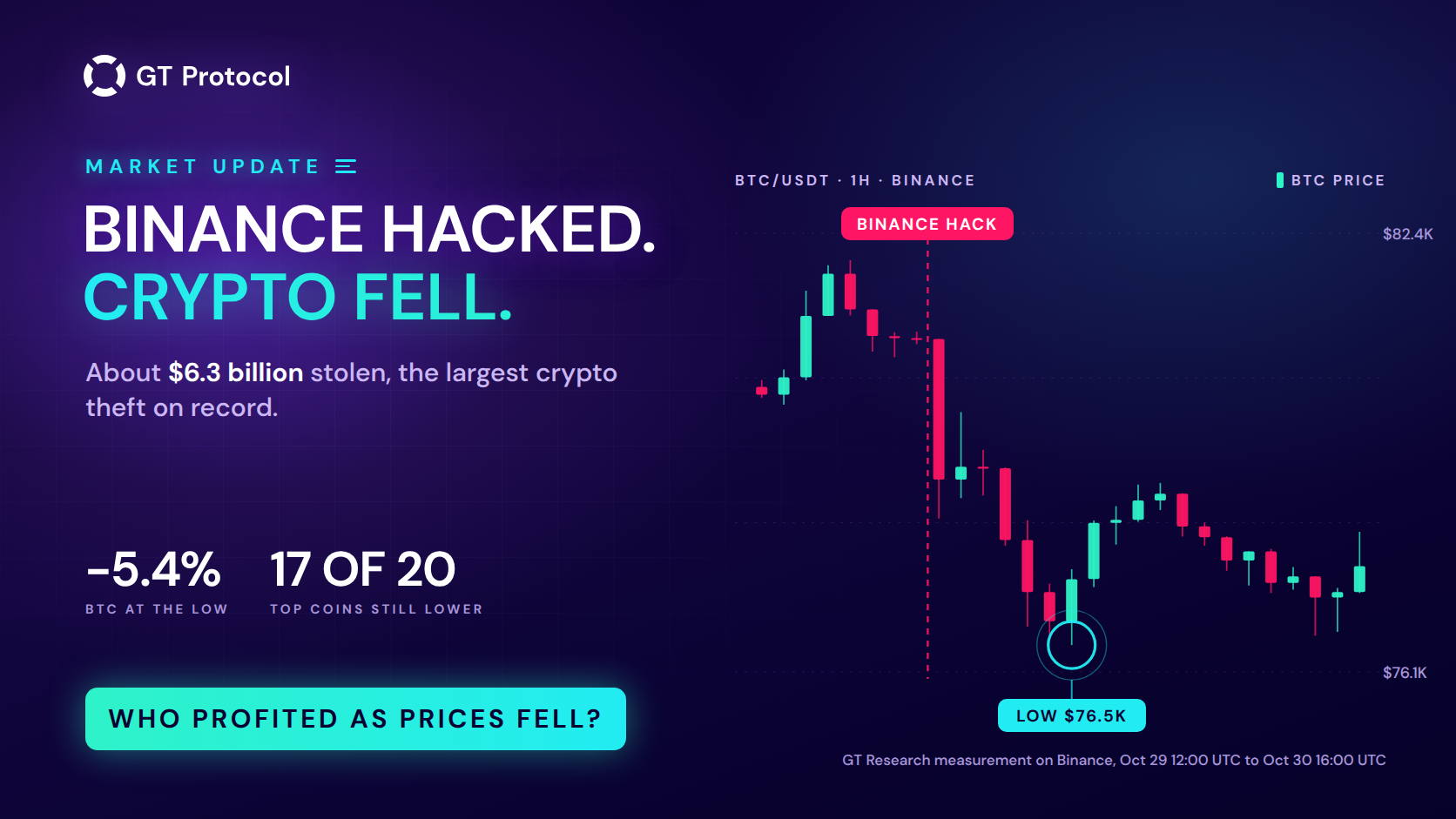
On October 29 hackers took about $6.3 billion from Binance, the largest crypto theft on record, and the market fell with it. In the 20 hours that followed, GT App users closed 99.5% of their completed real-money deals in profit, mostly with short strategies that earn when prices drop.
Below is what we measured: how far prices fell, what our users’ strategies did while they fell, why short strategies did best and which GT App tools are built for a day like this. The deal figures come from the platform’s own records, and the price moves are our own measurement on Binance. This is GT Research’s account of one day, not investment advice.
Table of contents
- What happened to the market after the Binance hack?
- How did GT App users make money while crypto fell?
- Why did short strategies work on a falling day?
- What about the deals that are still open?
- Which GT App tools help when the market falls?
- How can you try a short strategy without risking money?
- Frequently asked questions
What happened to the market after the Binance hack?
On Thursday, October 29, at about 20:00 UTC, attackers took funds from the hot wallets of Binance, the world’s largest crypto exchange: about $6.3 billion, roughly four times the Bybit hack of 2025 and the biggest theft the industry has seen. Binance paused deposits and withdrawals, said user funds were safe and promised to cover every loss. Trading itself did not stop. Binance’s hourly candles show its spot and futures markets trading through the whole night.
Prices did not wait. Bitcoin started sliding in the first minutes of the 20:00 UTC hour and in the 02:00 UTC hour touched $76,500, its lowest level since September 18. We measured each move on Binance from the price at 20:00 UTC on October 29, the hour the hack began.
| Coin | At the low | At 16:00 UTC |
|---|---|---|
| Bitcoin (BTC) | −5.4% | −4.0% |
| Ether (ETH) | −7.0% | −4.7% |
| BNB | −8.7% | −6.0% |
| Solana (SOL) | −7.5% | −5.0% |
| XRP | −6.4% | −2.1% |
| Zcash (ZEC) | −11.1% | −7.6% |
GT Research measurement on Binance spot prices, from 20:00 UTC on October 29 to 16:00 UTC on October 30, 2026. The low is each coin’s lowest price in that window.
The fall was broad. Of the 20 largest cryptocurrencies by market value that trade on Binance, stablecoins excluded, every one of them dropped below its 20:00 UTC price at some point, and 85% were still lower 20 hours later. Leveraged traders took the hardest hit: about $1.5 billion of positions were liquidated within a day, most of them bets on rising prices, according to CoinGlass data cited by several outlets.
How did GT App users make money while crypto fell?
By being on the right side of the move, again and again. Between 20:00 UTC on October 29 and 16:00 UTC on October 30, strategies on GT App completed real-money deals on their users’ own exchange accounts, each one closed by the strategy itself at its profit target or its stop-loss. 99.5% of them closed in profit. The only loss was a long position that hit its stop-loss at −5.65%.
| Side | Share of deals | In profit |
|---|---|---|
| Short | 96.2% | 100% |
| Long | 3.8% | 85.7% |
| All | 100% | 99.5% |
Real-money deals from the platform’s own records, 20:00 UTC on October 29 to 16:00 UTC on October 30, 2026. Demo trades and the GT team’s own accounts are excluded, as are deals their owners cancelled by hand and a deal whose record we could not verify.
The shorts carried the day. They made up 96.2% of the completed deals, and 100% of them closed in profit, each at between +0.56% and +0.64% of its volume after exchange fees, most often +0.62%. They came from short strategies on Binance futures accounts, and a single user runs 90% of those strategies. Zcash accounted for 74.7% of the short deals, NEAR for 12.4% and Polkadot for 9.0%, with Bitcoin Cash and Sui making up the remaining 3.9%. The two busiest strategies, both on Zcash, made 20.5% of all completed deals between them, 100% of them in profit. One of them got through its entire run of deals between 20:03 and 00:23 UTC, in just over four hours.
Longs made up the other 3.8% of completed deals. Of those, 85.7% closed in profit, at between +0.48% and +5.07%, and the only one that did not is the stop-loss above. A falling market still bounces, and a long with a modest target can close on a bounce.
Here, a percentage with a plus or minus sign is a deal’s profit as a share of its volume after exchange fees, as the platform records it, and a percentage without a sign is a share of the deals or strategies. We show percentages, not amounts, because deal sizes differ from one account to the next.
Why did short strategies work on a falling day?
A short sells first and buys back lower, so it earns when the price drops (how a Short works on spot and on futures). The strategies behind these deals paired that with a small target, a take profit of 0.5% that the app counts after fees, and opened the next deal soon after closing the last one. When the price falls in steps, a setup like this closes a deal on every step.
The deal record shows exactly that. Short deals closed in two waves: 39.9% of them in the 20:00 UTC hour, when Zcash fell almost 6% and the first and sharpest drop hit the whole market, and 23.0% around midnight UTC, when Zcash dipped to its lowest price of the night. Between the waves, as prices moved sideways, closes slowed to a handful an hour.
The same rules have a cost, and it is worth saying plainly. A short loses when the price rises, and a target that books +0.6% on each step also caps what one deal can make. Leverage multiplies both directions: most of these deals ran at 5x leverage, so a move against them weighs five times as much on the margin behind the deal. The results above describe one falling day, not a strategy that wins every day.
What about the deals that are still open?
A closed deal is a result; an open one is a position. These strategies open a new deal after closing one, so every one of them had a deal open again when we wrote this, at 16:20 UTC on October 30. With prices bouncing off their lows, 95% of those deals were below their entry. The deepest was 4.8% of its volume below, a Polkadot short at 10x leverage, where that move weighs about 48% on the margin behind it.
If the market keeps recovering, deals like these wait for the price to come back, and that is where safety orders, a stop-loss and a sensible leverage do their work. The 99.5% above counts completed deals only. It says nothing about the deals still open, which is why we show both.
Which GT App tools help when the market falls?
The users behind these deals did not predict the hack. They had rules in place before it, and the rules did the work. These are the GT App tools that matter most on a day like this:
- Short direction. A strategy can sell first and buy back lower, on spot or on futures, so a falling price is something it trades rather than waits out. See Long or Short.
- Trend Changer and Macro Trend Changer. Two settings that watch for a turn and can alert you or switch a strategy’s direction: Trend Changer follows your coin, Macro Trend Changer follows Bitcoin’s trend over months. See Macro Trend Changer.
- Dip Entry. Opens a deal only after the price falls a set percentage from its high of the last 1, 4, 12 or 24 hours, so a long does not start at the top of that window. See Dip Entry.
- Take profit. A target set as a percentage, counted from your average entry with trading fees built in. Small targets close often; larger ones wait for bigger moves. See take profit.
- Smart Exit. On real-money strategies, it closes a deal that is already in profit when the price stalls short of the target and reversal signals appear, and it never closes at a loss. See Smart Exit.
- Telegram notifications. Every deal a strategy completes arrives in your Telegram chat with its result, through our AI trading agent, so you can follow a night like this one as it happens. See notifications.
- Backtest and Optimize. Test a rule on real price history before it trades, and let Optimize try hundreds of versions of it in seconds. See backtesting and Optimize.
- AI-generated strategies. Ready-made futures strategies that four AI models propose every hour, each with a 30-day backtest and one click from the builder. See AI-generated strategies.
- Your own account on Binance or Hyperliquid. Strategies trade through a connection with trading permissions only, which can’t withdraw, and your funds stay on your own account. See non-custodial trading bots and the Hyperliquid setup.
How can you try a short strategy without risking money?
In demo mode. Every new GT App account gets two ready-made demo strategies, Demo Long and Demo Short, which trade the same futures pair with virtual money (what they are). In the same 20 hours, Demo Short closed 100% of its completed deals in profit, each at about +0.45%. That is virtual money, and nobody can withdraw it, but it shows how a short behaves on a falling day without putting a dollar at risk.
From there the path is the same for everyone: watch Demo Short, build your own strategy with the direction set to Short, backtest it, run it in demo and move to real money only when the rules make sense to you.
Frequently asked questions
Did GT App strategies keep trading during the Binance hack?
Yes. Binance paused deposits and withdrawals, not trading, and its spot and futures markets traded through the night. Strategies connected to Binance kept opening and closing deals through the 20 hours from 20:00 UTC on October 29, and 99.5% of the real-money deals they completed closed in profit.
Does GT App hold my funds?
No. Your funds stay on your own exchange account. GT App trades them through a connection with trading permissions only, which can’t withdraw, and you can delete that key on the exchange side whenever you like.
Why did short strategies make money when so many traders lost?
Because a short earns when the price falls. Most of the roughly $1.5 billion liquidated that day were leveraged bets on a rise, according to CoinGlass data cited by several outlets, and short strategies sit on the other side of that move. The same rules lose money when the price rises.
Were these real trades?
Yes. They were real-money deals on users’ own Binance and Hyperliquid accounts, taken from the platform’s deal records. Demo trades and the GT team’s own accounts are excluded, and each result is a percentage of the deal’s volume after exchange fees.
Can I test a short strategy before using real money?
Yes. Every new account gets Demo Short, which trades with virtual money, and any strategy you build can be backtested on real price history and run in demo mode before you connect real funds.
Is this article investment advice?
No. This article is GT Research’s own account, published for information. GT Protocol provides software, not financial, investment, tax or legal advice. The results of one day are not a forecast for any strategy or account, and every trading decision is the reader’s own.
The takeaway
The largest theft in crypto history sent every major coin lower within hours, and about $1.5 billion of leveraged bets were wiped out in a day. GT App users had their rules set before any of it: in the next 20 hours their strategies closed 99.5% of their completed real-money deals in profit, and 96.2% of those deals were shorts that earned as prices fell. The open deals are the other half of the story, and they are why a stop-loss and a sensible leverage matter as much as a profit target. To see deals like these as they happen, join the GT Protocol community chat. To set up and test your own rules, start with GT App in demo mode. The decision to trade is yours.
This article is the opinion of GT Research. It is not financial advice, and nothing here is a prediction or a promise of returns. Price changes were measured by GT Research on Binance spot markets, from 20:00 UTC on October 29 to 16:00 UTC on October 30, 2026; figures about the hack and liquidations are as reported at the time of writing and may be revised. Trading results come from real-money deals in GT App’s own records for the same window, exclude demo trades and the GT team’s accounts, and are shown as a share of each deal’s volume after exchange fees; they describe one day and do not predict what any user will achieve. Trading digital assets, especially with leverage, carries a risk of losing some or all of the funds committed. GT Protocol provides software, not financial, investment, tax or legal advice. GT App is not available in every jurisdiction; the Terms of Service list the restrictions.