
Dip Entry: How to Set Up a Buy-the-Dip Bot in GT App
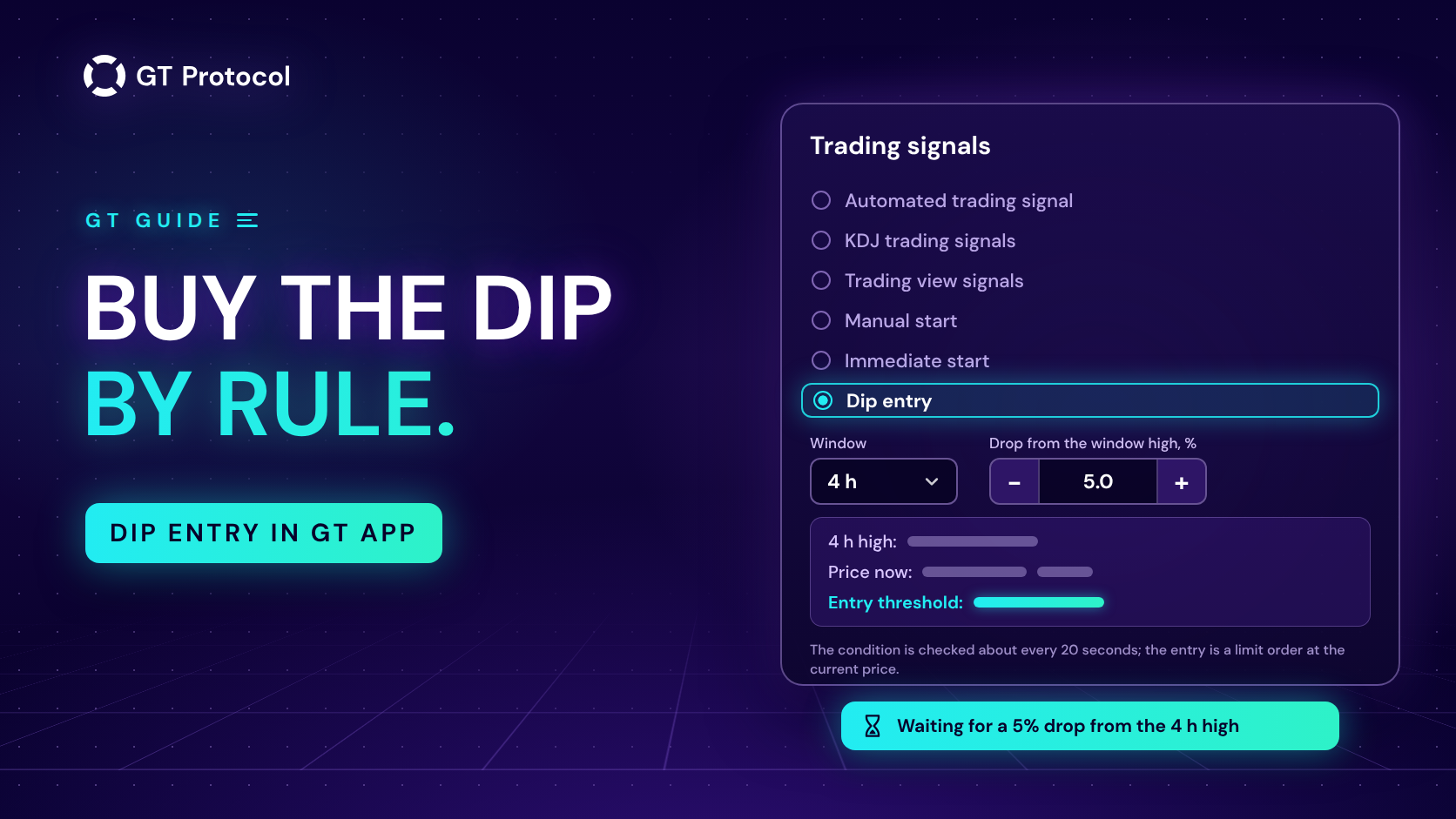
Dip Entry is a GT App entry setting that opens a deal only after the price falls a set percentage from its highest point of the last 1, 4, 12 or 24 hours. Instead of buying whenever the strategy starts, the bot waits for a pullback you chose in advance, so no deal opens at the top of that window.
This guide explains what the setting is for, what research says about buying dips in crypto, how GT App measures a dip, how often different settings fired over the past year, where the approach fails and how to set it up. It describes the app as of October 2026 and doesn’t tell you which coin or settings to trade.
Table of contents
- What is Dip Entry in GT App?
- What is Dip Entry for?
- What does research say about buying the dip?
- How does Dip Entry measure a dip?
- What happens after a Dip Entry deal closes?
- How often does a dip actually happen?
- What doesn’t Dip Entry do?
- How does Dip Entry compare with other entries?
- How do you set up Dip Entry in GT App?
- Frequently asked questions
What is Dip Entry in GT App?
Dip Entry is the sixth way a GT App strategy can decide when to open a deal. In the strategy form, the options sit under Trading signals: the Automated trading signal, built on Bollinger Bands; KDJ trading signals; TradingView signals; Manual start; Immediate start; and Dip entry. You set two things: a Window of 1, 4, 12 or 24 hours, and a percentage from 0.5 to 50 in steps of 0.1. For a Long strategy the field reads “Drop from the window high, %”, for a Short strategy “Rise from the window low, %”. The form fills in 4 hours and 5% when you pick the option. There is no timeframe, because no indicator is involved: the rule is plain price. Everything after the entry works as in any other strategy, with the start order, safety orders, take profit and stop loss you set. Dip Entry works on Binance spot and futures and on Hyperliquid, for real and demo strategies.
What is Dip Entry for?
Dip Entry is for traders who know the rule “buy low” and want a bot that keeps it. Buying into a fall is uncomfortable and buying after a rise feels safe, so many entries end up near local highs. The setting moves that decision to a calm moment: you choose in advance how big a pullback is worth buying and over what period, and the bot waits for exactly that, around the clock. It fits three uses:
- Entering a coin you already want, but not on a spike. The bot waits until the price is at least your percentage below its recent high.
- Starting a safety-order ladder lower. Safety orders average the entry down if the price keeps falling. With Dip Entry the first order goes in after a drop has already happened, not at whatever price there was when you pressed Launch.
- Selling into a spike on futures. A Short strategy waits until the price has risen your percentage above its recent low.
It also trades each dip only once; the section on closed deals explains why.
What does research say about buying the dip?
The case for buying after a drop rests on one idea: sharp moves often overshoot. Research on crypto prices supports that idea in part and shows where it breaks.
- Sharp Bitcoin drops have tended to overshoot. José Luis and María Mar Miralles-Quirós studied hourly Bitcoin price shocks (Journal of Applied Economics, 2022) and found clear evidence of overreaction after negative shocks, strongest 6 to 24 hours after the drop.
- The bounce is not universal. Adam Zaremba and co-authors (International Review of Financial Analysis, 2021) found that coins with the weakest return on one day tended to outperform those with the strongest return the next day, but the effect came from illiquid coins. The largest, most liquid coins showed the opposite: daily momentum.
- Crypto trends. Yukun Liu and Aleh Tsyvinski (Review of Financial Studies, 2021) found a strong time-series momentum effect in cryptocurrency returns: past moves tended to continue rather than reverse.
- Newcomers tend to buy after a rise. A 2022 Bank for International Settlements working paper by Raphael Auer, Giulio Cornelli, Sebastian Doerr, Jon Frost and Leonardo Gambacorta tracked crypto app use in 95 countries and found that a rising Bitcoin price is followed by an influx of new users. The authors estimate that around three quarters of users lost money on their Bitcoin investments.
- Waiting has a cost. Nick Maggiulli gave a saver perfect knowledge of every market bottom in US stocks (Of Dollars And Data, 2019). Buying only at those bottoms still lost to plain monthly buying in more than 70% of the 40-year periods he tested, because the market kept rising while the saver waited.
Our reading: the research doesn’t say that dips always recover. It says that sharp drops often overshoot in the short run, that large coins can keep falling, and that most people buy after a rise. A rule set in advance is one way to break that habit. Maggiulli studied long-term saving in stocks, not bots, but the mechanism carries over: the deeper the dip you wait for, the less often your strategy trades. These studies describe past samples, and none of them tested GT App.
How does Dip Entry measure a dip?
Dip Entry works with two numbers: the highest price of your window and the current price. The window high is the top of the closed 5-minute candles over the last 1, 4, 12 or 24 hours; a candle that is still forming counts only once it closes. The entry threshold is that high minus your percentage: with a 4-hour window, 5% and a 4-hour high of 100,000 USDT, it is 95,000. About every 20 seconds, the bot compares the current price with the threshold, and once the price is at or below it, opens a deal with a limit order at the current price. A Short strategy measures from the lowest price of the window and waits for a rise of your percentage.
Before you launch, the form shows the window high, the current price with its change from that high, and the entry threshold. If the price is already past the threshold, a warning says the bot will enter right after launch; on a running strategy with no open deal, saving such a change asks for confirmation. If no running strategy uses that pair and window yet, the hint is marked “Approximate” until the platform has its own level. Because of the 20-second check, a wick that lasts a few seconds can come and go unseen, and in a fast market the entry can land slightly below the threshold.
What happens after a Dip Entry deal closes?
Suppose the bot bought a 5% dip and the deal closed at take profit on the bounce. The price may still be more than 5% below the old 4-hour high, so a naive rule would open a new deal at once, into the same dip. Dip Entry doesn’t. For one window length after a Dip Entry deal closes, the bot measures the drop from the highest price since the exit. The strategy form says so: “High since the last deal closed” and “The bot has already traded this dip and is waiting for a new one.” Once a full window has passed, the bot measures from the window high again. A deal opened by another entry, before you switched the strategy to Dip Entry, doesn’t count as an exit from a dip. While the strategy waits, its deal status says what it is waiting for, for example “Waiting for a 5% drop from the 4 h high”.
How often does a dip actually happen?
How often a setting fires decides how often the strategy trades, so we measured it on public Binance futures 5-minute candles for BTC, ETH and SOL from 13 October 2025 to 12 October 2026, with the bot’s rule: the highest price of the closed candles in the window, minus the percentage. The table counts the days, out of 365, on which the condition was met at least once. The bot checks every 20 seconds rather than every tick, so the real count can be slightly lower.
| Window, drop | BTC | SOL |
|---|---|---|
| 1 h, 1% | 284 | 343 |
| 1 h, 2% | 112 | 224 |
| 4 h, 2% | 187 | 296 |
| 4 h, 3% | 77 | 186 |
| 4 h, 5% (default) | 17 | 60 |
| 12 h, 5% | 32 | 112 |
| 24 h, 5% | 59 | 154 |
| 24 h, 10% | 4 | 28 |
ETH landed between the two in every row, with 52 days for the default setting. Three things stand out. The same setting means different things on different coins: the default fired on 17 days for BTC and 60 for SOL, so a percentage that suits a volatile altcoin can leave a BTC strategy idle for weeks. A longer window also counts slow slides: 5% from the 24-hour high fired on 59 days for BTC against 17 for the 4-hour window, because a gradual decline reaches the threshold without a sharp move. And small settings stop being a filter: 1% from the 1-hour high fired on most days of the year, and the strategy behaves almost like Immediate Start with a short pause.
What doesn’t Dip Entry do?
Dip Entry decides when a deal starts. It doesn’t know where the bottom is. For each day the default setting fired, we compared the entry level with the lowest price over the next 24 hours.
| Coin | Median | Over 5% |
|---|---|---|
| BTC | 2.7% | 2 of 17 |
| ETH | 2.7% | 12 of 52 |
| SOL | 3.7% | 17 of 60 |
“Median” is how far below the entry level the price typically went within a day; “Over 5%” counts the days on which it fell more than another 5%. The deepest cases were 11% for BTC, 15% for ETH and 24% for SOL. Dips also came in clusters: 14 of BTC’s 17 days fell between mid-November 2025 and late February 2026, while Bitcoin slid from about 103,000 to below 60,000 USDT. On 5 February 2026, the default setting would have fired at about 67,300, and within 24 hours the price touched 59,800, 11% lower. That is the momentum the research describes: in a falling market, a dip is often not the last one. Three settings therefore matter more than the percentage:
- Safety orders. Size the ladder so it can follow the price several percent below the entry within your balance. Our guide to setting safety orders shows how to check the total.
- Stop loss. Decide in advance what loss ends a deal, and whether the strategy keeps running afterwards (action “Close deal”) or stops (“Stop the strategy and close the deal”).
- A cap on deals. Open several deals & stop pauses the strategy after a set number of deals, so a losing streak stops by itself.
How does Dip Entry compare with other entries?
All six entries decide only when a deal starts. They differ in what they wait for and in what happens once a deal ends: some go straight back into the market, others wait for a new condition.
| Entry | Waits for | Next deal |
|---|---|---|
| Dip entry | A drop of your % from the window high | After a fresh dip |
| Automated signal | A Bollinger Bands signal | On the next signal |
| KDJ | A KDJ signal | On the next signal |
| TradingView | Your alert | On the next alert |
| Immediate start | Nothing | At the next check |
| Manual start | Your button press | When you press it |
The indicator entries depend on a timeframe; our KDJ guide shows how much the signal count changes with it. Dip Entry has none, so you see the exact price it waits for before you launch. The table describes GT App as of October 2026.
How do you set up Dip Entry in GT App?
Dip Entry lives in the full strategy form, not on the quick strategy screen that runs a backtest, because the backtest engine doesn’t model this entry. On an existing strategy, open its settings and change the entry the same way.
- Open My Strategies. For spot, press Create Spot Strategy. For futures or demo, press Create Futures Strategy or Create Demo Strategy, then Advanced settings. On some accounts the form opens straight away.
- Choose the exchange, direction and pair, and set the amounts. How Much Money Do You Need to Start a Crypto Trading Bot? walks through the arithmetic.
- Under Trading signals, select Dip entry.
- Pick the Window and the percentage, keeping in mind how far the coin usually moves; the table above gives a sense of scale.
- Read the hint under the fields: window high, current price, entry threshold. If it warns that the bot will enter right after launch and you would rather wait, raise the percentage.
- Size the safety orders, set a stop loss if you use one, and consider Open several deals & stop.
- Launch on demo first: it runs on live prices without real money. Paper Trading Your First Bot covers what to watch.
Without a backtest, a demo run is the first honest test of a setting; our comparison of backtesting and paper trading explains what each test can tell you. An open deal is managed like any other, as How to Manage an Active Deal in GT App shows.
Frequently asked questions
Does Dip Entry buy the bottom?
No. It buys after the price has fallen your percentage from its recent high. With the default setting, the price typically kept falling after that point: by a median of 2.7% to 3.7% within a day for BTC, ETH and SOL in our year of data.
What if the price is already below the threshold when I launch?
The bot enters right after launch, and the form warns you before you press the button. To wait for a new dip instead, raise the percentage or choose a longer window.
Will the strategy buy the same dip twice?
No. For one window length after a Dip Entry deal closes, the bot measures from the highest price since the exit, so it waits for a fresh drop.
Can I use Dip Entry on a Short strategy?
Yes. A Short strategy waits for the price to rise your percentage above the lowest price of the window.
Can I change the window or percentage on a running strategy?
Yes, from the next check. If the strategy has no open deal and the new values already meet the condition, the app asks you to confirm, and the bot enters right after you save.
Which exchanges and strategy types support Dip Entry?
Binance spot and futures and Hyperliquid, real and demo. If you copy a strategy that uses Dip Entry, the copy opens its deals together with the original.
Is this article investment advice?
No. It is published by GT Research for information. GT Protocol provides software, not financial, investment, tax or legal advice. Settings and figures here describe how the tool works and how prices moved in the past; they are not recommendations or forecasts, and every trading decision is the reader’s own.
Where to start
Pick a pair you know and create a demo strategy in GT App with Dip entry, a percentage that matches how far that coin usually moves, a safety-order ladder that fits your balance and a cap on deals. Let it trade a few dips, then compare how often it entered and how deep the deals went with what you expected. If you are new to the app, Four Steps from Sign-Up to Real-Money Trading in GT App shows where the plan and the exchange connection fit in.
This article is published by GT Research for information. It describes how Dip Entry works in GT App and how prices moved in the past, and it is not financial advice. Nothing here is a prediction or a promise of returns, and the research cited describes past market samples. Demo results are simulations and do not predict how a strategy will perform with real funds. Trading digital assets, and futures in particular, carries a risk of losing some or all of the funds committed. GT Protocol provides software, not financial, investment, tax or legal advice. Binance and Hyperliquid are third-party platforms with their own terms, and GT App is not available in every jurisdiction; the Terms of Service list the restrictions.