
Backtesting vs Paper Trading: Which Test to Trust?
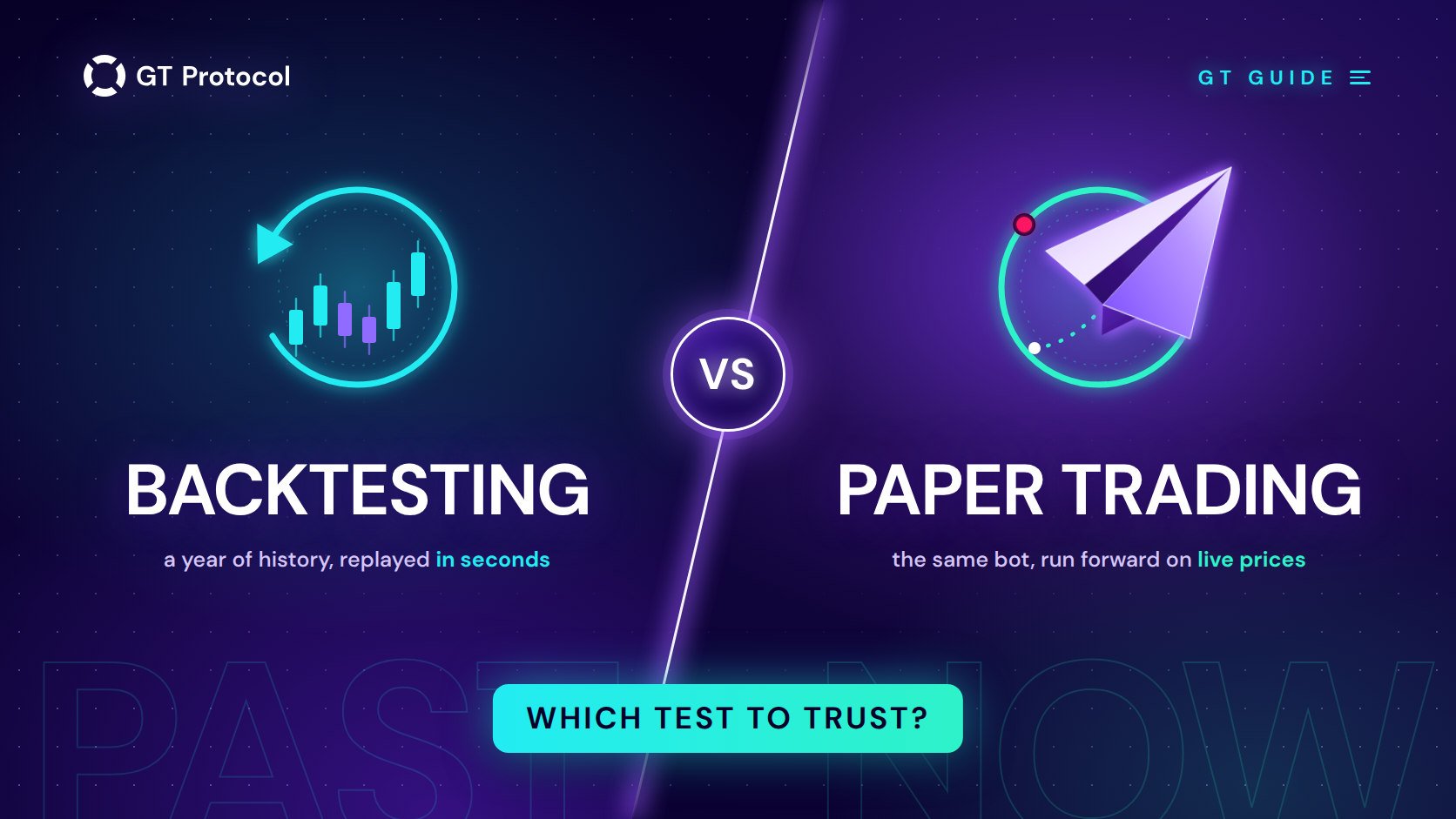
Backtesting replays a trading strategy on historical prices in seconds. Paper trading runs the same strategy forward on live prices with simulated money. A backtest shows whether the rules held up across many market conditions; paper trading shows whether the bot behaves as designed today. Trust neither alone: run both, in that order, then go live small.
This guide is for anyone about to put money behind an automated strategy. It covers what each test can and cannot prove, a side-by-side table, the order we run them in, and how both work in GT App, where a free backtest and a demo bot use the same settings as a live one.
Table of contents
- What is the difference between backtesting and paper trading?
- What can a backtest tell you that paper trading cannot?
- Where do backtests mislead?
- What does paper trading prove that a backtest cannot?
- Where does paper trading mislead?
- How do backtesting and paper trading compare side by side?
- In what order should you test a trading bot?
- How do you run both tests in GT App?
- What mistakes do traders make when testing bots?
- Frequently asked questions
What is the difference between backtesting and paper trading?
Backtesting is a simulation that applies a strategy’s rules to past market data and reports what would have happened. Paper trading is a simulation that applies the same rules to the live market as it unfolds, with a simulated balance instead of real funds. The difference is the direction of time. A backtest looks backward and compresses months into seconds, so one run can cover hundreds of deals and several market moods. Paper trading looks forward and moves at the speed of the market, so two weeks of testing produce two weeks of evidence. That makes the two tests answer different questions. A backtest asks whether the rules had an edge across a long, varied stretch of history. Paper trading asks whether the bot you configured does what you intended when real prices arrive in real time. Traders also call paper trading forward testing or demo trading; in GT App the mode is called Demo Trading.
Neither test places an order on an exchange, and neither can lose money. That is their value and their limit: both leave out the parts of trading that only exist when money is on the line.
What can a backtest tell you that paper trading cannot?
A backtest gives you sample size, and sample size is what separates a pattern from a coincidence. In a few seconds it can replay about a year of minute-level history for a pair, which for an active strategy means hundreds of simulated deals. A month of paper trading might close ten. With that much data you can check things a short forward test never reveals: how deep the worst drawdown went, whether profits came from the whole period or from one lucky stretch, and how the strategy handled a rally, a sell-off and a flat market. A backtest is also the only practical way to compare settings. Changing the take profit from 1% to 2% and rerunning takes seconds, while the same comparison on paper would take weeks per variant. Use that speed to reject ideas. A strategy that fails on history with realistic costs has not earned a place in a forward test.
As a working floor we look for a triple-digit number of deals in the tested window, spread across the period rather than clustered in one month. How to Read a Backtest Report covers the numbers to check one by one.
Where do backtests mislead?
Backtests mislead in three ways: they flatter tuned settings, they can assume fills nobody would have got, and they often leave out costs. The first is overfitting. If you adjust parameters until the past looks perfect, the settings describe the noise of that particular year rather than anything that will repeat. A stable strategy degrades gently when you nudge a parameter; an overfit one falls apart. The second is execution. A simulation that fills orders at prices the signal could not have known at the time will report profits that were never available. The third is friction. Every live trade pays a fee and gives up a little price to the spread, and a report that assumes zero cost overstates the result, most of all for strategies with small targets and many deals. Perpetual futures add funding payments, which accrue for as long as a position with borrowed exposure stays open.
In GT AI Backtest, fees and slippage are off by default. Switch on Override Fees & Slippage before you judge a result. We start from 10 basis points of fees and 5 of slippage, applied on entry, on every safety order and on exit. Funding on perpetuals is not modelled, so read the reported profit of a long-held futures strategy as an upper bound.
What does paper trading prove that a backtest cannot?
Paper trading proves that the bot you built behaves the way you think it does, on the market as it is now. A demo bot watches the same live price feed as a real one and opens and closes simulated deals by the same rules, so it exposes configuration mistakes that no backtest summary will show. You see whether entries fire when you expect, how often safety orders trigger, whether the stop loss closes the deal where you set it, and how long capital sits in an open position. You also meet the pace of real trading. A backtest hides the three days in which nothing happens and the afternoon when four deals open at once; a forward test makes you live through both. Last, paper trading checks the present. History may not contain the conditions of this month, and a forward run is the only test that uses them.
It also tests you. If a 15% simulated drawdown makes you want to step in and change the settings, a real one will too. That is cheaper to learn on a demo balance.
Where does paper trading mislead?
Paper trading misleads mainly through small samples and perfect fills. Two weeks of demo results cover one market mood. If that stretch happened to suit the strategy, a handful of winning deals will look like proof, and it is not: ten closed deals say something about behaviour and almost nothing about profitability. The second problem is execution. A demo bot fills at the prevailing market price, with no order book to move and no queue to wait in. Live orders pay exchange fees, cross a spread and can slip during fast candles, and thinly traded pairs make this worse. In GT App, demo results do not include real order-book slippage or exchange fees, so a strategy that only just breaks even on paper will look worse once real costs apply. The third problem is the balance itself. A simulated 10,000 dollars behaves differently from the 500 you plan to deposit, because order sizes and safety-order ladders scale with it.
How do backtesting and paper trading compare side by side?
The two tests are complements, not rivals, and the table below shows why. Wherever one is weak the other tends to be strong. A backtest is fast and broad but lives entirely in the past, so its typical failure is a strategy tuned to history. Paper trading is slow and narrow but runs on the present, so its typical failure is a conclusion drawn from too few deals. Neither includes the full cost of live execution, which is why a third stage with a small real balance still matters. Read the rows as a checklist of what you have and have not yet verified. If you have only backtested, you know nothing about how the bot behaves in real time. If you have only paper traded, you know nothing about how the rules fare outside the last few weeks. A strategy is tested when every row has an answer you are comfortable with.
| Aspect | Backtest | Paper trading |
|---|---|---|
| Market data | Historical candles | Live prices in real time |
| Time needed | Seconds per run | Days to weeks |
| Sample size | Hundreds of deals | A handful of deals |
| Market conditions | Whatever the history holds | Only the current one |
| Comparing settings | Fast, many variants | Slow, one at a time |
| Fees and slippage | Modelled once switched on | Not included in demo results |
| Typical failure | Overfitting to the past | Trusting too few deals |
| Tests best | Whether the rules had an edge | Whether the bot behaves as designed |
| Pressure on you | None | Low, the money is simulated |
| Cost in GT App | Free, first run needs no account | Free on every registered account |
The GT-specific rows describe GT AI Backtest and Demo Trading as they work in September 2026.
In what order should you test a trading bot?
Test in three stages: backtest first, paper trade second, then go live with a small balance. Each stage costs more time or money than the one before, so its job is to stop weak ideas from reaching the next. Stage one is the backtest with fees and slippage switched on. Look for a triple-digit number of deals, a worst drawdown you could sit through, and profits spread across the period rather than packed into one month. Stage two is a demo bot with the same settings, the same pair and a balance close to what you plan to deposit. Run it for at least one to two weeks and until it has closed ten or more deals, and read the trading logs rather than the profit figure. Stage three is real money at a fraction of the planned size (we use about a quarter), so that real fees and fills can show their effect before you scale up.
A strategy can fail at any stage, and that is the reason to have stages. Passing all three is still not a guarantee. Markets change, and a test only covers the conditions it ran in. Keep the demo running after you go live: it is a free control group, and a sharp gap between demo and live results on the same pair is worth investigating before you add capital.
How do you run both tests in GT App?
In GT App both tests use the same strategy settings, so nothing has to be rebuilt between them. GT AI Backtest runs in the browser and is free, and the first run does not need an account. You pick one of the strategy cards the AI generates each day or build your own: pair, timeframe, direction, take profit, stop loss, leverage and safety orders. Results arrive in seconds with win rate, profit, a chart with deal markers and the full list of deals, and the Optimize button sweeps ranges of settings to show which region of values the strategy prefers. From a result you can send the same configuration to GT App as a demo bot. Demo Trading is open to every registered account without a paid plan and covers both Binance and Hyperliquid strategies. When the demo has earned it, the Launch Real button on the strategy card starts the same configuration on your connected exchange. Real trading requires a membership plan.
For futures strategies the build, backtest and launch steps now sit on one screen inside the app. Two companion guides go deeper on each half: Free AI Crypto Backtesting and Paper Trading Your First Bot.
What mistakes do traders make when testing bots?
The most common mistake is optimizing until the backtest looks perfect and then treating that result as a forecast. An optimizer ranks variants by how much they would have made on one historical window, and the top of that ranking is where overfit settings collect. Prefer a region of settings that all perform acceptably over a single peak that towers over its neighbours. The second mistake is testing one thing and trading another: a backtest on a major pair followed by a live launch on a small-cap one, or a demo with a simulated balance twenty times the real deposit. The third is stopping the forward test early because the first deals were winners. Three profitable deals in an afternoon prove almost nothing, and the urge to go live right then is strongest exactly when the evidence is weakest. Decide the pass criteria before the test starts, write them down, and hold to them.
Other habits that spoil a test:
- Judging a backtest with fees and slippage left at zero.
- Changing settings in the middle of a demo run, which resets the evidence to nothing.
- Looking at profit and ignoring the worst drawdown, which decides whether you would have stayed in.
- Launching a bot that opened a deal you cannot explain. Understand the trigger first.
Frequently asked questions
Is backtesting or paper trading more accurate?
Neither is more accurate, because they measure different things. A backtest is better evidence about whether the rules had an edge, since it covers far more deals and market conditions. Paper trading is better evidence about how the configured bot behaves in real time. Both leave out some real-world costs, so live results usually differ from each.
How long should you paper trade a crypto bot?
Our working minimum is one to two weeks and at least ten closed deals, whichever takes longer. Count deals rather than days: a slow strategy may need a month to close ten. The goal is to see the bot’s rhythm and check its behaviour, not to prove profitability, which a sample that small cannot do.
Can a strategy pass a backtest and still lose money?
Yes. The usual reasons are overfitting, costs the backtest did not include, and market conditions that differ from the tested period. A passed backtest means the idea was not rejected by history. It is a filter for weak strategies, not a promise about future results.
Does paper trading include fees and slippage?
In GT App, demo results do not include exchange fees or real order-book slippage. Demo bots react to live prices, but their orders are simulated. Expect a live version of the same strategy to do somewhat worse, and start it with a smaller balance so you can measure the difference.
Is forward testing the same as paper trading?
In practice, yes. Forward testing means running a strategy on new data as it arrives instead of on history, and doing that with simulated money is paper trading. Some traders also use forward testing for a live run with a very small balance, which adds real fills and fees to the picture.
Can I backtest and paper trade for free?
Yes. GT AI Backtest is free and the first run needs no account. Demo Trading is available to every registered GT App user without a paid plan. A membership plan is needed only when you start trading with real funds on a connected exchange.
Is this article investment advice?
No. It is published by GT Research for information. GT Protocol provides software, not financial, investment, tax or legal advice. Strategy settings mentioned here are examples of how the tools work, not recommendations, and every trading decision is the reader’s own.
Where to start
Run the cheap test first. Open GT AI Backtest, switch on fees and slippage, and see whether your idea survives a year of history. If it does, send it to GT App as a demo bot and let it close ten deals before you decide anything. The two tests together take a couple of weeks and cost nothing, which is little to spend before real money is involved.
This article is published by GT Research for information. It is not financial advice, and nothing here is a prediction or a promise of returns. Backtests and demo results are simulations and do not predict how a strategy will perform with real funds. Trading digital assets, and futures in particular, carries a risk of losing some or all of the funds committed. GT Protocol provides software, not financial, investment, tax or legal advice. GT App is not available in every jurisdiction; the Terms of Service list the restrictions.