
CLARITY Act, Two Days Later: The Market Held Its Ground
On September 16 GT Research argued that the CLARITY Act’s failure in the Senate was a setback, not a structural break for crypto. Two days later the market has absorbed a second test, the Federal Reserve’s first rate hike since 2023, and by midday on September 18 Bitcoin traded about 3% higher than when we published. This is our update.
In that article we said we would stop watching Congress and watch three other things: the Federal Reserve, flows into U.S. spot Bitcoin funds, and whether regulators would find a route to clarity that does not need 60 Senate votes. All three moved this week. Below is what happened to each, what prices did, where we could still be wrong, and what one live bot run by a member of our team did while the headlines played out. As before, this is GT Research’s opinion, not investment advice and not a forecast.
What happened to the CLARITY Act after the vote?
Nothing that reverses Tuesday, and two small things that keep a door ajar. The recorded tally on the motion was 49 in favour and 50 against, 11 short of the 60 it needed. One of the Republican no votes was procedural: Senator Thom Tillis switched to no and entered a motion to reconsider, which preserves the possibility of another vote, according to Newsweek. On Wednesday night seven Democratic senators who back the bill, among them Kirsten Gillibrand and Mark Warner, called the week “a setback, but not the end” in a joint statement and committed to keep negotiating, without naming a date. Congress spends much of October out of session, so the realistic window is the lame-duck session between November’s midterm elections and January.
On Wednesday we wrote that we saw nothing in the calendar to suggest the Senate would return to the bill this year. These two facts argue a little the other way, and we now treat a lame-duck vote as a possibility, though not as a plan. Either way our conclusion holds: the timeline moved, and the rules the market runs on did not.
How did crypto take the Fed’s first hike since 2023?
Better than a first hike usually suggests, and for a reason. On Wednesday the Federal Open Market Committee voted 12 to 0 to raise its target range by a quarter point, to 3.75% to 4%, its first increase since July 2023. The move was expected: before the decision CME FedWatch put the probability of a hike at 92%, and right after it Bitcoin swung between roughly $75,000 and $76,500, according to The Block. On Thursday prices rose, and CoinDesk counted 94 of the 100 tokens in its CoinDesk 100 index higher and its small-cap index up 4.7%, against 1.2% for its index of the five largest tokens. The committee’s median projection puts rates at 4.1% at the end of both 2026 and 2027, which implies one more quarter-point increase.
In our reading, markets react to surprises, and a hike that was 92% expected, with a short path drawn behind it, was not one. One number we measured ourselves on Binance: Bitcoin’s low after the Fed decision, near $75,060, held just above the low it set in the hour of the Senate vote, near $74,970. Two negative headlines in two days, and the second one did not take Bitcoin below the first.
What did fund flows and regulators do?
Flows into U.S. spot Bitcoin funds did what a nervous week predicts, and then turned. Investors pulled about $450 million from the funds on Tuesday and about $296 million on Wednesday, then put about $160 million back in on Thursday, according to Farside Investors data; Ether funds were still seeing outflows on Thursday. One day of inflows is not a trend, and we will not call it one. It is the first reading in the right direction since the vote.
The route that does not need 60 votes moved faster than we expected. On Thursday the Securities and Exchange Commission granted an exemption that lets qualifying platforms trade tokenized versions of U.S.-listed stocks on public blockchains without registering as national securities exchanges, as reported by CNBC and Decrypt. It takes effect immediately, runs for up to five years and covers only tokens that carry the same rights as the shares behind them, including dividends and votes. SEC officials described it as a bridge to permanent rules and possibly to future legislation.
This is the regulatory route we said we were watching, and it also shows the cost we named. An exemption granted by one commission can be narrowed by the next; a statute would have been far harder to undo, and that durability is what the failed vote cost. Both halves of our argument turned up in one announcement.
Where do prices stand two days later?
Higher across the board. We measured the change on Binance from the hour our article went live, 09:00 UTC on September 16, to 13:00 UTC on September 18.
| Asset | Change | Note |
|---|---|---|
| Bitcoin | +3.0% | Above its level on the evening of the vote |
| Ether | +4.1% | |
| Solana | +9.0% | |
| XRP | +3.0% | Hardest-hit major token on vote day |
| NEAR | +53.4% | A move specific to NEAR; see the bot below |
GT Research measurement on Binance spot prices. Two days of prices say little on their own and will be stale by the time you read this.
Every asset in the table trades above its level on the morning after the vote, with the first Fed rate increase in more than three years in between. NEAR is the outlier: its jump is a story of its own that no Senate vote explains, and it matters here only because one of our team’s bots trades it.
Which well-known coins rose over the last 24 hours?
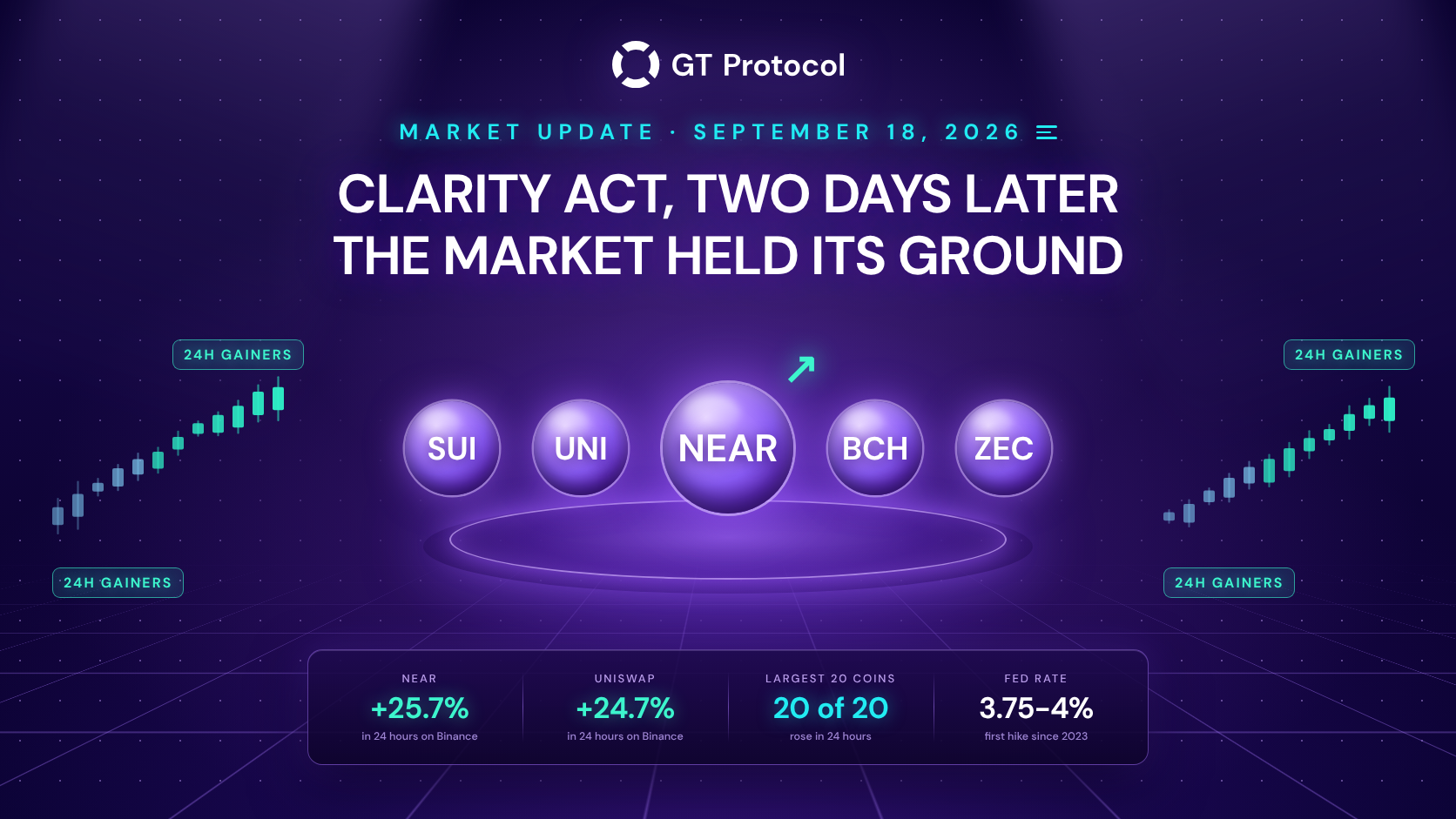
All of the ones we checked. We took the 20 largest cryptocurrencies by market value that trade on Binance, leaving out stablecoins, and measured each one over the 24 hours to 13:00 UTC on September 18. Every one of the 20 ended the day higher. The ten biggest moves:
| Coin | 24h change |
|---|---|
| NEAR Protocol (NEAR) | +25.7% |
| Uniswap (UNI) | +24.7% |
| Bitcoin Cash (BCH) | +10.7% |
| Sui (SUI) | +10.5% |
| Zcash (ZEC) | +7.8% |
| Cardano (ADA) | +7.0% |
| Shiba Inu (SHIB) | +6.3% |
| Avalanche (AVAX) | +5.2% |
| Dogecoin (DOGE) | +5.1% |
| Solana (SOL) | +5.0% |
GT Research measurement on Binance spot prices, 13:00 UTC on September 17 to 13:00 UTC on September 18, 2026; the 20 coins are the largest by market value on September 18 that trade on Binance, stablecoins excluded.
The other ten rose less: Chainlink about 4.8%, Litecoin 4.5%, Hedera 2.8%, Gram (formerly Toncoin) 2.6%, BNB 2.4%, Ether 1.7%, Bitcoin 1.7%, XRP 1.4%, Tron 1.0% and Stellar 0.9%. In our reading, a rise this broad, with the largest gains away from Bitcoin, is what a market looks like once it stops selling a headline. One day of it is not a trend, and none of these moves is a reason to buy the coin behind it.
Could we still be wrong?
Yes, and the strongest argument against us is historical. When the Fed began its previous hiking cycle on March 16, 2022, Bitcoin was about 40% below its November 2021 record, roughly where it is today against last October’s record of about $126,000. Over the next 12 days it rallied about 17%, and by mid-June it had fallen more than 60% from that rally’s high. We measured those moves on Binance ourselves, and the comparison is close enough that this update is not a victory lap.
The difference we see is the path behind the hike. In March 2022 the Fed was starting from near zero and went on to lift rates above 5% within 16 months; this week’s projections point to one more increase and a plateau at 4.1%. That is a difference in the backdrop, not a guarantee of a different outcome, and projections change. If fund outflows resume or the Fed’s next steps turn out steeper than projected, prices can follow them, CLARITY or no CLARITY. Two days of prices do not prove a thesis. What they show is narrower: neither headline this week removed the ground the market stands on.
What did a live bot on our team do this week?
While the Senate, the Fed and the SEC made the headlines, a bot that a member of the GT team runs on a real Binance account kept doing what it was set up to do in May. It trades NEAR against USDT on the spot market with deliberately simple rules: buy, sell once the price is 1% higher (the target was raised to 1.2% on Friday morning), one deal at a time, no averaging orders and no stop-loss. It does not read the news. It reads the price.
Its previous deal was opened on June 3. NEAR then fell by as much as half, to its August low, and the deal stayed open for 106 days, below its entry price at 105 of 106 daily closes. On the evening of September 17, as NEAR climbed back above the entry, it closed at +0.98%. Within the next 15 hours the bot opened and closed 16 more deals, and every one of them ended in profit.
| Closed (UTC) | Held | Result |
|---|---|---|
| Sept 17, 22:51 | 106 days | +0.98% |
| Sept 17, 23:25 | 34 min | +0.98% |
| Sept 18, 01:20 | 1 h 55 min | +0.99% |
| Sept 18, 01:32 | 12 min | +0.97% |
| Sept 18, 01:35 | 3 min | +0.99% |
| Sept 18, 02:35 | 59 min | +0.98% |
| Sept 18, 02:57 | 22 min | +0.97% |
| Sept 18, 03:03 | 6 min | +0.98% |
| Sept 18, 03:04 | 1 min | +0.97% |
| Sept 18, 03:09 | 4 min | +0.97% |
| Sept 18, 03:56 | 47 min | +0.98% |
| Sept 18, 04:49 | 52 min | +0.99% |
| Sept 18, 10:25 | 5 h 36 min | +0.98% |
| Sept 18, 13:04 | 2 h 38 min | +1.19% |
| Sept 18, 13:28 | 24 min | +1.17% |
| Sept 18, 13:32 | 4 min | +1.18% |
| Sept 18, 13:34 | 3 min | +1.19% |
Result is each deal’s profit as a share of its volume after exchange fees, from the platform’s own deal records. The last four deals ran with the raised 1.2% target.
Since it was started on May 8, the bot has closed 79 deals, and all 79 closed in profit, at between +0.94% and +1.19% each.
Now the part a screenshot leaves out. A bot that sells only at a profit target and has no stop-loss closes its deals only at that target, so every deal it closes ends in profit by design. The risk does not go away; it moves into the open position. This summer it sat there for 106 days, at one point about 50% below the entry, and it paid off only because NEAR came back. Had it not, that capital would still be tied up in a losing position. A 1% target also does not try to catch a whole rally: NEAR rose about 21% over the same hours, so simply holding the coin would have made more on this particular day. What the target does is turn a rally into a series of closed gains that stay closed if the move reverses. This describes one bot’s rules and history. It is not a recommendation to trade without a stop-loss, and one account’s results say nothing reliable about anyone else’s. At the time of writing, its 80th deal is open. Until it closes, it is a position, not a result.
On GT App, strategies like this run on the user’s own Binance or Hyperliquid account through an exchange API key configured without withdrawal rights (more on why that matters), and a rule can be backtested on historical candles or run in demo mode before real money is committed. Those are properties of the tools, not claims about results.
Where can you see live results and ask questions?
In the GT Protocol community chat on Telegram. It has more than 48,000 members, and it is where traders share closed deals from their own bots, compare settings and ask the questions an article cannot answer for them: why a take-profit sits where it does, how long a deal can stay open, how others set up the same pair. If you run strategies on GT App, or are still deciding whether to, join the GT Protocol community chat and ask. One rule we apply to every results post, ours included: people share wins more readily than losses, so ask about the drawdown behind a screenshot and judge a strategy by its full history, the way we tried to above.
Frequently Asked Questions
Is the CLARITY Act dead after the September 15 vote?
Not formally. The procedural motion failed 49 to 50, and a motion to reconsider entered by Senator Thom Tillis keeps a path to another vote open. Seven Democratic senators who support the bill have said they will keep negotiating. The realistic window is the lame-duck session after November’s midterm elections, and both its timing and its outcome are unknown.
Why did crypto rise after the Fed raised rates?
In our reading, because the hike was expected and the path behind it looks short. Before the September 16 decision, CME FedWatch put the probability of a quarter-point hike at 92%, according to The Block, and the Fed’s median projection implies only one more increase. Markets tend to move on surprises, and this decision was largely priced in.
Were the NEAR deals in this article real trades?
Yes. They were executed on the spot market of a real Binance account run by a member of the GT team, not in demo mode. The results come from the platform’s own deal records and are shown as percentages of each deal’s volume, after exchange fees.
Can a trading bot close every deal in profit?
A bot that sells only at a profit target and has no stop-loss closes deals only at that target, so every deal it closes ends in profit unless someone closes it by hand. That is a property of its rules, not a guarantee of results. The risk moves into the open position, which can stay below its entry for months or never recover. The bot in this article held one deal for 106 days, at one point about 50% below the entry, before it closed at +0.98%.
How do I join the GT Protocol community chat?
Open t.me/gtprotocol in Telegram and join. The chat has more than 48,000 members; traders share closed deals and settings there and ask questions about strategies and GT App.
Is this article investment advice?
No. This article is GT Research’s own opinion, published for information. GT Protocol provides software, not financial, investment, tax or legal advice, and does not act as anyone’s advisor. The results of one bot on one account are not a forecast for any other strategy or account, and every trading decision is the reader’s own.
The takeaway
Two days, two headlines that could have shaken the market’s footing: a failed Senate vote and the first Fed rate hike since 2023. Crypto absorbed both and traded higher by midday on September 18 than when we published, all 20 of the largest coins on Binance rose over the day, spot Bitcoin funds took in money again on Thursday, and the SEC opened a route that did not need Congress. None of that proves our reading, and the 2022 comparison is a warning we take seriously. What the week does show is the value of rules set before the headline: a bot configured in May needed no opinion on the Senate or the Fed to close 17 deals in profit in under a day, and its 106-day deal shows what the same rules cost when the market goes the other way. To see results like these as they happen, join the GT Protocol community chat. To build and test your own rules, start with GT App. The decision to run them is yours.
This article is the opinion of GT Research. It is not financial advice, and nothing here is a prediction or a promise of returns. Price changes were measured by GT Research on Binance spot markets, from 09:00 UTC on September 16 and over the 24 hours to 13:00 UTC on September 18, 2026; other figures are as reported by the named sources, and all of them will be stale by the time you read this. A price move over one day is not a recommendation to buy or sell any coin. The trading results described come from one bot on one account run by a member of the GT team; they are not a measure of what other users achieve and do not predict future results. Trading digital assets carries a risk of losing some or all of the funds committed. GT Protocol provides software, not financial, investment, tax or legal advice. GT App is not available in every jurisdiction; the Terms of Service list the restrictions.