
CLARITY Act Fails: Why the Blow May Be Smaller Than It Looks
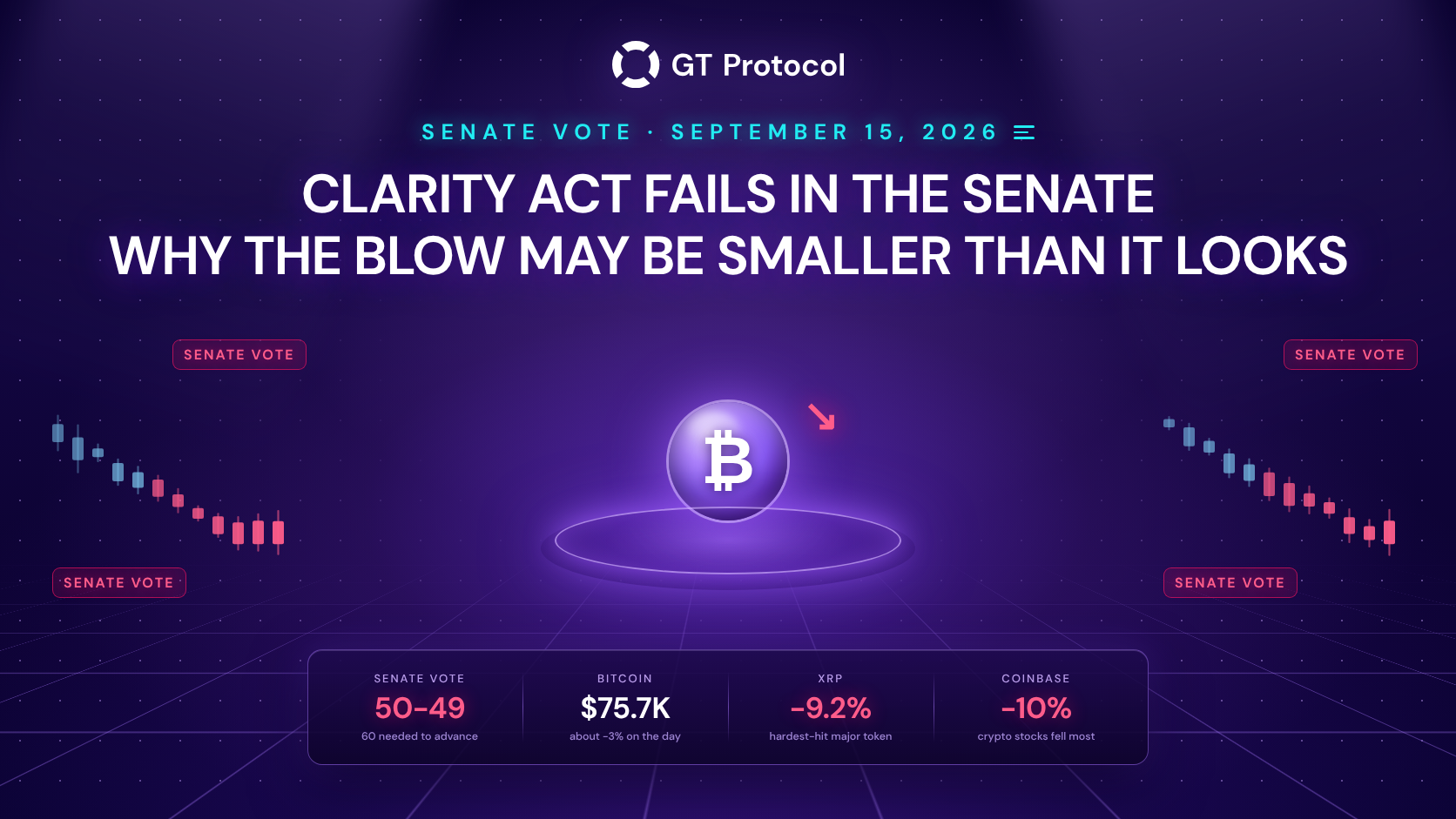
On September 15, 2026 the U.S. Senate declined to open debate on the CLARITY Act, and crypto sold off within hours. The setback is real. In our view it is also narrower than the headlines suggest: the vote moved the timeline of one bill, not the rules, products and flows the market already runs on.
This is GT Research’s reading of the week, not a summary of anyone else’s. It lays out what was actually voted on, what prices did, why we call the result a setback rather than a structural break, and where the picture is genuinely worse than it was on Monday. The last section is for readers who run rules-based strategies on GT App. Nothing here is investment advice, and none of it is a forecast.
We noted in August that the bill was heading into this vote reported to be short of the 60 votes it needed. The outcome was the expected one. The reaction is what needs explaining.
What exactly did the Senate vote on?
The Senate held a procedural vote on whether to begin debating the Digital Asset Market Clarity Act, the market-structure bill the House of Representatives passed in July 2025. Moving forward required 60 votes. The motion drew 50 in favour and 49 against, according to CNBC, so debate never opened. This was not a vote on the bill’s content. Had it passed, the Senate would still have needed to debate the text, vote on passage and agree a final version with the House before anything reached the President. According to CNBC and CoinDesk, the motion broke down over ethics language covering the crypto holdings of public officials, not over the market-structure provisions themselves: Republican leaders had released a revised text with new ethics restrictions on the Sunday before the vote, and a Democratic counterproposal was rejected hours before it. CoinDesk reported that this ends Senate work on market-structure legislation for 2026, with November’s midterm elections ahead and the timing of any second attempt unclear. We see nothing in the calendar that argues otherwise.
The bill itself was a framework, not a product. It would have divided oversight of digital assets between the Securities and Exchange Commission and the Commodity Futures Trading Commission, set out how tokens are classified, created registration requirements for exchanges and other intermediaries, and added customer-asset and anti-money-laundering provisions; our July article covers the text in more detail. None of that existed on Monday, and none of it was taken away on Tuesday. What was lost is a timeline, and possibly a legislative window.
How did the market react?
Prices fell across the board, and the fall was steeper the closer an asset sat to the bill. Bitcoin traded near $75,750 late on Tuesday, down about 3% on the day according to The Block, roughly 4.5% below Monday’s high near $79,400 and about 8% below the month’s high above $82,000 set on September 4. Ether lost about 4.5%, Solana about 5.4% and XRP about 9.2%. Listed crypto companies were hit hardest: Coinbase fell more than 10%, Circle about 11%, Bitmine about 8% and Strategy about 5%. Part of the move came before the roll call. CoinDesk reported that the odds of the bill advancing on the prediction market Polymarket halved overnight, from 34% to 17%, once the ethics dispute became public, and Bitcoin had already given back Monday’s gain by Tuesday morning. Our reading of that sequence is that a failed vote was largely priced in by Tuesday morning and a surprise passage was not, which is why the roll call itself moved prices less than the ethics dispute that preceded it.
| Asset | Move on Sept 15 | Note |
|---|---|---|
| Bitcoin | About -3%, near $75,750 | Monday high near $79,400; September 4 high above $82,000 |
| Ether | About -4.5% | |
| Solana | About -5.4% | |
| XRP | About -9.2% | Largest fall among the major tokens |
| Coinbase | More than -10% | Exchange; a direct beneficiary of a federal registration path |
| Circle | About -11% | Stablecoin issuer |
| Bitmine | About -8% | Ether treasury company |
| Strategy | About -5% | Bitcoin treasury company |
Figures are from The Block’s report late on September 15, 2026 and CoinDesk’s live coverage the same evening; snapshots a few hours apart differ by a point or two, and all of them will be stale by the time you read this.
The table is the first clue that the damage is uneven rather than total. The assets that fell most are the ones whose business depends on a U.S. registration path or a classification test. Bitcoin, which already has a settled classification and regulated investment products, fell least. The next sections explain why we think that split is the right way to read the week.
Why do we call it a setback rather than a structural break?
Our case rests on one observation and one distinction. The observation: every price Bitcoin has ever printed, including its all-time high, was printed without the CLARITY Act on the books. The market reached its current levels in a world where the law did not exist, so the absence of the law does not remove the ground it stands on. The distinction: a structural blow takes away something the market relies on, while a setback delays something it hoped for. Tuesday did the second. In our reading, legislation was never the binding constraint on this market. This cycle has followed interest rates, dollar liquidity and fund flows far more closely than any single bill, which moves the questions that matter from Congress to the Federal Reserve, to exchange-traded fund flows and to regulatory routes that do not need 60 Senate votes. That is an opinion, and we hold it with the usual caveat that markets do not owe anyone consistency.
We should also be fair to the other side of the argument, because it exists. Even a successful procedural vote would have left the bill far from becoming law, and a market that rallied on Monday’s odds was, in our view, too focused on the outcome in both directions. The vote was a missed opportunity for momentum, and lost momentum is a real cost in a market that runs on it. But a missed opportunity and a broken foundation are different things, and the rest of this article is about keeping them apart.
What did not change on Tuesday?
Every regulated channel that existed before the vote still exists after it. Spot Bitcoin exchange-traded funds have traded in the United States since January 2024 and spot Ether funds since mid-2024; the vote did not touch their approval or their operation. The federal stablecoin law signed in July 2025 remains in force. The Commodity Futures Trading Commission has treated Bitcoin as a commodity for a decade, and the Securities and Exchange Commission published its own proposal for crypto-asset rules in August, a proposal that runs through the agency’s rulemaking process rather than through Congress. Exchanges kept operating, custodians kept custody, and the institutions that hold Bitcoin through funds, treasuries and structured products held it on Wednesday morning exactly as they did on Monday. The CLARITY Act would have put a full federal statute on top of this plumbing. Failing to add the statute left the plumbing where it was.
This is the core of our case that the blow is smaller than it looks. A structural blow removes something the market relies on: an ETF wrapper withdrawn, banks barred from custody, a stablecoin framework struck down. None of that happened. A future improvement was postponed, and postponements have a cost, covered below, but it is a different kind of cost.
Does the vote hit Bitcoin and the rest of the market the same way?
No, and Tuesday’s prices already showed the split. Bitcoin sits inside a framework that no longer depends on new legislation: commodity treatment, spot funds, deep regulated derivatives markets and a growing place in traditional portfolios, from ETFs to corporate treasuries. The parts of the bill that mattered to Bitcoin holders were incremental. For everything else the calculation is different. Exchanges wanted a federal registration path instead of state-by-state licences and case-by-case enforcement. Token issuers wanted a test for when a token is a security and when it is a commodity. Stablecoin issuers, custodians and DeFi projects wanted the same certainty. For them the bill was not incremental, which is why their shares and tokens fell harder and why the setback is real for that side of the market. The table below sets the two out side by side.
| Aspect | Bitcoin | Everything else |
|---|---|---|
| Regulatory status today | Treated as a commodity; spot ETFs live since January 2024 | Classification decided case by case |
| What the CLARITY Act would have added | A statute on top of an existing framework | The framework itself: classification, registration, customer-asset rules |
| Move on September 15 | About -3% | Ether -4.5%, Solana -5.4%, XRP -9.2%; Coinbase -10%, Circle -11% |
| Main price drivers, in our view | Rates, liquidity, ETF flows | The same macro drivers plus regulatory clarity and token-specific catalysts |
| What the failed vote changes | The timing of a catalyst | The timing of the rulebook these businesses were waiting for |
Price moves are from The Block, late on September 15, 2026; the drivers row and the last row are GT Research’s assessment.
Where is the picture genuinely worse than before?
Three things are worse, and none of them should be softened. First, time. If Senate work on market structure is finished for 2026, as CoinDesk reports, the next realistic window opens after November’s midterm elections, in a Congress whose composition is unknown, with a House bill that will by then be more than a year old. Second, durability. Rules made by agencies can be revised by the next set of agency heads; a statute would have outlasted them, and the businesses that wanted CLARITY wanted it for that reason. Third, competition. The European Union’s MiCA framework has applied in full since the end of 2024, and other jurisdictions wrote their rules while the United States debated. Add the smaller cost we named above, a lost catalyst for momentum, and our honest summary is that Tuesday removed an upside case rather than creating a new downside one.
What are we watching instead of Congress?
We are watching three things, and none of them sits in the Senate. The first is the Federal Reserve: whether its next decisions and guidance point to a longer-term path for rates, because a cycle that in our reading is rates dependent will follow that path more closely than any headline out of Washington. The second is spot ETF flows: they are the measurable form of institutional demand, they are published daily, and whether they turn positive again tells us more than any roll call. The third is whether regulators find a route to clarity that does not require 60 Senate votes, through agency rulemaking, guidance and enforcement priorities; the SEC’s August proposal is one such route, and its progress is worth following. We also watch where capital moves inside the market rather than out of it. One number we measured ourselves: the Ether-to-Bitcoin ratio rose about 18% between the July 1 and September 15 daily closes on Binance, which tells us that rotation inside crypto continued through a difficult quarter rather than stopping.
These are possibilities, not outcomes: easier financial conditions can fail to arrive, ETF flows can stay negative for months, agencies can move slowly. What the list does is reframe the question. In our view, whether crypto recovers in the coming quarter depends less on this week’s vote and more on whether the monetary and liquidity backdrop improves, and that is a question this article cannot answer for you. The vote created uncertainty about the U.S. rulebook. It did not remove the reasons the market existed before the rulebook was drafted.
What does a week like this mean for a rules-based trading process?
A headline week tests process rather than opinion, and this one landed on a Tuesday afternoon with most of the move compressed into a few hours. A rules-based strategy handles it the way it handles any other day: the position size, the stop-loss and the take-profit were set before the vote, and the software acts on price, not on the roll call. On GT App, strategies run on the user’s own Binance or Hyperliquid account through an exchange API key configured without withdrawal rights, and a strategy can be backtested on historical candles or run in demo mode before any capital is committed. These are properties of the tools, not claims about results. Automation removes hesitation; it does not remove risk, and a bot follows a badly set rule as faithfully as a good one. A backtest shows how a rule behaved on past headline shocks, not how it will behave on the next one.
For a public view of how automated agents handled the week, the GT AI Hedge Fund publishes its models’ reasoning every six hours. It is an open experiment, not an investment product, and a deposit there can lose value as easily as gain it.
Frequently Asked Questions
What is the CLARITY Act?
The CLARITY Act, formally the Digital Asset Market Clarity Act, is a proposed U.S. federal law that would set out a framework for digital asset markets: which regulator oversees which assets, how tokens are classified, how exchanges and other intermediaries register, and how customer assets are protected. It passed the House of Representatives in July 2025 and has not passed the Senate.
Did the Senate reject the CLARITY Act?
Not on its merits. On September 15, 2026 the Senate voted on a procedural motion to begin debating the bill. The motion needed 60 votes and received 50, with 49 against, according to CNBC. Reporting attributes the failure to a dispute over ethics language covering public officials’ crypto holdings rather than to the market-structure provisions.
Is the CLARITY Act dead?
The bill has not been withdrawn, but CoinDesk reports that the vote ends Senate work on market-structure legislation for 2026. Any second attempt would come after November’s midterm elections, and its timing and text are unknown.
Why did crypto stocks fall more than Bitcoin?
Because, in our reading, the bill mattered more to them. An exchange or a stablecoin issuer would have gained a federal registration path and a settled rulebook; Bitcoin already has commodity treatment and spot ETFs. On September 15 Coinbase fell more than 10% and Circle about 11%, against about 3% for Bitcoin, according to The Block.
Does the failed vote change how Bitcoin ETFs or stablecoins are regulated?
No. Spot Bitcoin and Ether ETFs were approved under existing securities law, and the federal stablecoin law was signed in July 2025. Neither depended on the CLARITY Act, and neither was affected by the vote.
Is this article investment advice?
No. This article is GT Research’s own opinion, published for information. GT Protocol provides software, not financial, investment, tax or legal advice, and does not act as anyone’s advisor. Prices and vote counts here are as reported by third parties on September 15, 2026, and every trading decision, on GT App or anywhere else, is the reader’s own.
The takeaway
The CLARITY Act’s failure to clear the Senate is a setback, and for exchanges, issuers and the tokens still waiting for a classification test it is a costly one: a lost year at least, and a rulebook that will now be written, if at all, by a different Congress. In our view it is not a structural blow to the market as a whole, because nothing the market runs on today was removed, and the questions we are asking about the coming quarter are about rates and flows, not about a roll call. For anyone running strategies through the noise, the useful question is not what the Senate does next but whether the rules were set before the headline. GT App is where those rules can be built, backtested and run. The decision to run them is yours.
This article is the opinion of GT Research. It is not financial advice, and nothing here is a prediction or a promise of returns. Prices and percentage moves are as reported by The Block and CoinDesk on September 15, 2026 and will be stale by the time you read this. Trading digital assets, especially with leverage, carries a risk of losing some or all of the funds committed. GT Protocol provides software, not financial, investment, tax or legal advice. GT App is not available in every jurisdiction; the Terms of Service list the restrictions.