
TradFi Futures for AI Trading: Gold, Oil, Indices, NVIDIA and More
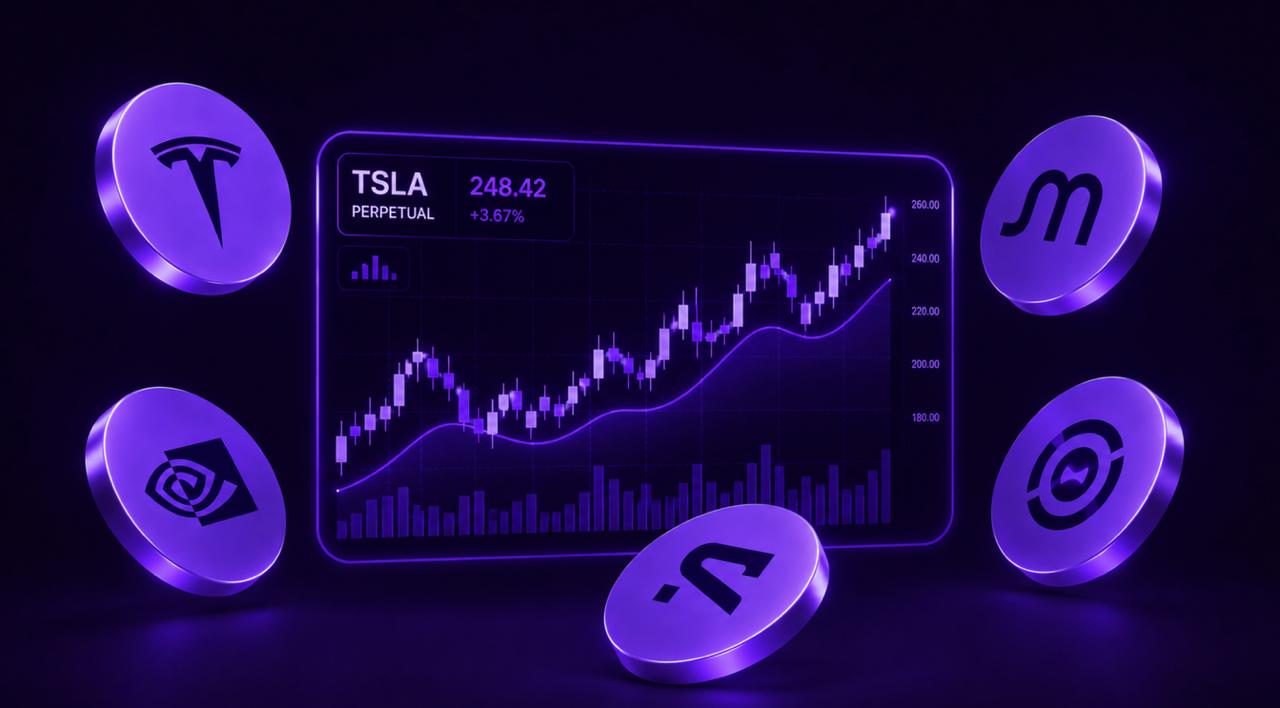
Alongside tokenized stocks on spot, GT App now gives you the futures side of traditional markets: precious metals and energy, ETFs tracking the broad US indices and several regional markets, and the largest American technology and semiconductor names. These are TradFi perpetual futures — contracts margined and settled in USDT, trading around the clock, in the same futures section where you already run bots on BTC and ETH. You can open them in GT App with the same strategies you use for crypto: signal bots, Trend Changer, safety orders, Smart Exit.
The difference from the tokenized stocks on spot is not the ticker list, which largely overlaps. It is the mechanics. A spot bStock is backed by a real share held with a custodian, and a position in it can only be long. A perpetual is a derivative: nothing is held behind it, but the position can be opened in either direction, collateral is posted in USDT, and the contract has no expiry date.
Under the hood these are Binance USDⓈ-M TradFi-Perps: synthetic perpetuals tracking an oracle price of the underlying, funded by a periodic funding rate the same way BTC and ETH perps are. From the bot’s point of view they behave like any other USDT-margined futures market on the venue.
What a TradFi perpetual is
A TradFi perpetual is a futures contract that tracks the price of a traditional-market asset — a metal, a barrel of crude, an index ETF, a US-listed stock — without a delivery date. It settles in USDT, uses an oracle price of the underlying as its reference, and stays open until you close it or the margin behind it runs out. Position direction is up to you, collateral is posted rather than the full notional, and a funding rate keeps the contract anchored to the underlying.
There is no quarterly roll and no expiry to manage. That is the appeal for a systematic strategy: a position lives as long as the logic says it should live, not until the calendar forces it to close.
Because there is no expiry to force the contract back in line with the underlying, that job falls to the funding rate: a periodic payment flowing between longs and shorts depending on which way the contract trades relative to the index. Funding is a running cost or credit on an open position, and on anything held for weeks it stops being a rounding error. For a strategy that carries positions rather than closing them intraday, it belongs in the arithmetic.
The second difference is margin. You post collateral rather than the full value of the position. This works both ways: the same price move produces a proportionally larger result on the account, and a move against the position can take the margin down to a level where the exchange closes it out. Nothing about the underlying being a blue-chip stock or a metal changes that mechanic.
And a perpetual carries no claim on the underlying. You are not a shareholder, there are no dividends, and there is no metal in a vault with your name on it. What the contract tracks is a price.
What is available in GT App
The TradFi perpetuals catalogue in GT App covers four blocks: precious metals, energy and industrial metals, index ETFs, and US-listed technology and semiconductor names. Every contract is quoted and settled in USDT, and all of them trade in the futures section of the app under the same order types and bot templates you already use for crypto. The list below is grouped by what the underlying actually is, because the drivers of gold are not the drivers of NVIDIA and a strategy that ignores that tends to learn it the expensive way.
Precious metals
- Gold (XAU). The oldest monetary metal and the reference point for the whole commodity complex. Its price tends to be driven by inflation expectations, real interest rates and demand for a defensive asset during periods of uncertainty.
- Silver (XAG). Part monetary metal, part industrial input — it goes into solar panels, electronics and medical equipment. That dual character historically makes it more volatile than gold and gives it a second set of drivers on the demand side.
- Platinum (XPT). A rare metal used heavily in automotive catalytic converters and in fuel-cell technology, so its price reflects the state of the auto industry and the pace of the energy transition.
- Palladium (XPD). Also concentrated in catalytic converters, and unusually sensitive to supply: production is dominated by a small number of countries, which makes supply-chain and geopolitical developments a bigger factor than for the other metals.
Energy and industrial metals
- Crude oil (CL). One of the most heavily traded commodities in the world, sitting upstream of transport costs and headline inflation. It responds to production decisions, inventories and global demand.
- Copper (COPPER). Used across construction, electronics and manufacturing, which is why its price is watched as a proxy for industrial activity. It tends to move with the direction of the global economy rather than with any single sector.
Index ETFs
- SPX — the S&P 500. The broadest read on US large caps. Whatever else your book is doing, an SPX perpetual is the cleanest way to express a view on the market as a whole rather than on a single name.
- Regional and sector ETFs. The catalogue also includes ETFs tracking non-US developed markets and sector baskets, quoted the same way and settled in USDT. These matter for anyone who wants exposure to a market that is closed for most of the crypto trading day.
Big Tech and semiconductors
- NVIDIA (NVDA), AMD, AVGO, ARM. The semiconductor complex — the direct expression of the AI-compute build-out.
- Apple (AAPL), Microsoft (MSFT), Alphabet (GOOGL), Amazon (AMZN), Meta (META). The five megacaps that carry most of the weight of the US indices. A view on the S&P 500 is largely a view on these names.
- Tesla (TSLA). High-beta name with its own idiosyncratic drivers, useful when a strategy wants volatility that isn’t correlated to the rest of the tech book.
- Crypto-adjacent equities: Coinbase (COIN), MicroStrategy (MSTR), Robinhood (HOOD), Circle (CRCL). Publicly traded proxies for crypto exposure. On days when the underlying moves hard, these frequently move harder.
- Palantir (PLTR), Alibaba (BABA). Two names that respond to a different set of catalysts — enterprise/government AI on one side, China policy on the other.
Why this changes what a bot can do
The obvious change is the ticker list. The less-obvious one is when the bot works. Crypto trades non-stop, and the same is true of these TradFi perpetuals: the contracts are open 24/7, even though the underlying stock or metal market they reference is closed for most of that window. The oracle keeps updating on holidays and weekends, and news that breaks after the New York close no longer waits for the next session to be priced in. A bot on NVDA can act on an earnings-adjacent move at 22:00 UTC on a Tuesday the same way a bot on ETH would.
The second change is direction. On spot, exposure to a stock is long or nothing. On a perpetual, a bot can short the same name with the same tooling, hedge a spot position, or run pair trades between two correlated names — one long, one short — with USDT collateral on both legs.
The third change is that a single account now covers three books that used to require three brokers: crypto perps, commodity exposure, and US equity exposure. Cross-margin, one balance, one set of PnL numbers. Every GT strategy that already works on BTC and ETH — DCA, Grid, Trend Changer, signal bots, Smart Exit — runs on these symbols with the same parameters. The bot doesn’t know or care whether the ticker is BTC or NVDA; it acts on price series and follows its rules.
What to watch out for
Three things are worth knowing before you point a bot at these markets.
Funding on carried positions. A perpetual held through a strong trend accrues funding. Long positions in a market where longs are crowded pay funding to shorts; the reverse holds when shorts are crowded. On a swing strategy that closes intraday this is negligible. On a Trend Changer position held for two weeks in a heavily one-sided market, it isn’t. Check funding history on the symbol before treating any long-hold backtest as final.
Liquidity outside cash hours. The contract trades 24/7, but the depth is not uniform across the day. Around US cash-market open and close the book is deepest and slippage is smallest; on a Sunday night the same market order will move price further. Bots using limit orders are largely unaffected; anything relying on market fills should be sized with the thin windows in mind.
Weekend gap risk. The underlying stock market closes on Friday and reopens on Monday. The oracle continues to update through the weekend on news, but the price on Monday’s open can arrive as a step rather than a smooth path. Position sizing needs to allow for that step being against you.
Frequently Asked Questions
What is a TradFi perpetual futures contract?
A TradFi perpetual is a USDT-margined futures contract that tracks the price of a traditional-market asset — a stock, a metal, a commodity, an index ETF — with no expiry date. It settles in USDT rather than the underlying, references an oracle price, and stays open until closed manually or liquidated. A funding rate keeps it anchored to the underlying instead of an expiry.
How is a TradFi perpetual different from a tokenized stock?
A tokenized stock (a spot bStock in GT App) is backed by a real share held with a custodian, and you can only be long. A TradFi perpetual is a derivative with no underlying asset held: you can be long or short, you post USDT as margin rather than paying the full price, and you pay or receive funding while the position is open.
Do these contracts pay dividends?
No. A perpetual futures contract has no claim on the underlying company or asset. There are no dividends, no shareholder voting rights, and no delivery. What the contract tracks is a price.
Can bots trade TradFi perpetuals the same way they trade BTC perps?
Yes. Every GT strategy — DCA, Grid, Trend Changer, signal bots, safety orders, Smart Exit — works on TradFi perpetual symbols with the same parameters as on crypto. The bot treats them as regular USDT-margined futures markets.
Do these markets close on weekends?
No. The perpetual contracts trade 24/7, including weekends and traditional-market holidays. The underlying stock or commodity market may be closed, but the oracle and the perpetual contract continue to trade and update.
What is the funding rate and when does it matter?
The funding rate is a periodic payment between longs and shorts that keeps the perpetual’s price aligned with the underlying oracle. On intraday strategies it is usually negligible. On positions held for days or weeks — particularly in a heavily one-sided market — it becomes a meaningful line item in the PnL and should be included in strategy design.
Is my margin at risk of liquidation?
Yes. Perpetual futures are margined products: you post collateral rather than the full notional value of the position. If the market moves against the position and the margin runs down to the maintenance level, the exchange closes it out. Position sizing and stop levels matter more than they do on spot.
Trading TradFi perpetuals in GT App
The TradFi perpetuals catalogue is live in the futures section of GT App, alongside crypto perps. Any bot template that already works on BTC/USDT or ETH/USDT works on XAU/USDT, NVDA/USDT or SPX/USDT with no strategy rewrite. The underlying is different; the mechanics are the same.
Why these markets are worth the attention this year is a separate story: the best trade of 2026 wasn’t a coin — it was memory chips, while crypto drifted.