
The Best Trade of 2026 Isn't a Coin
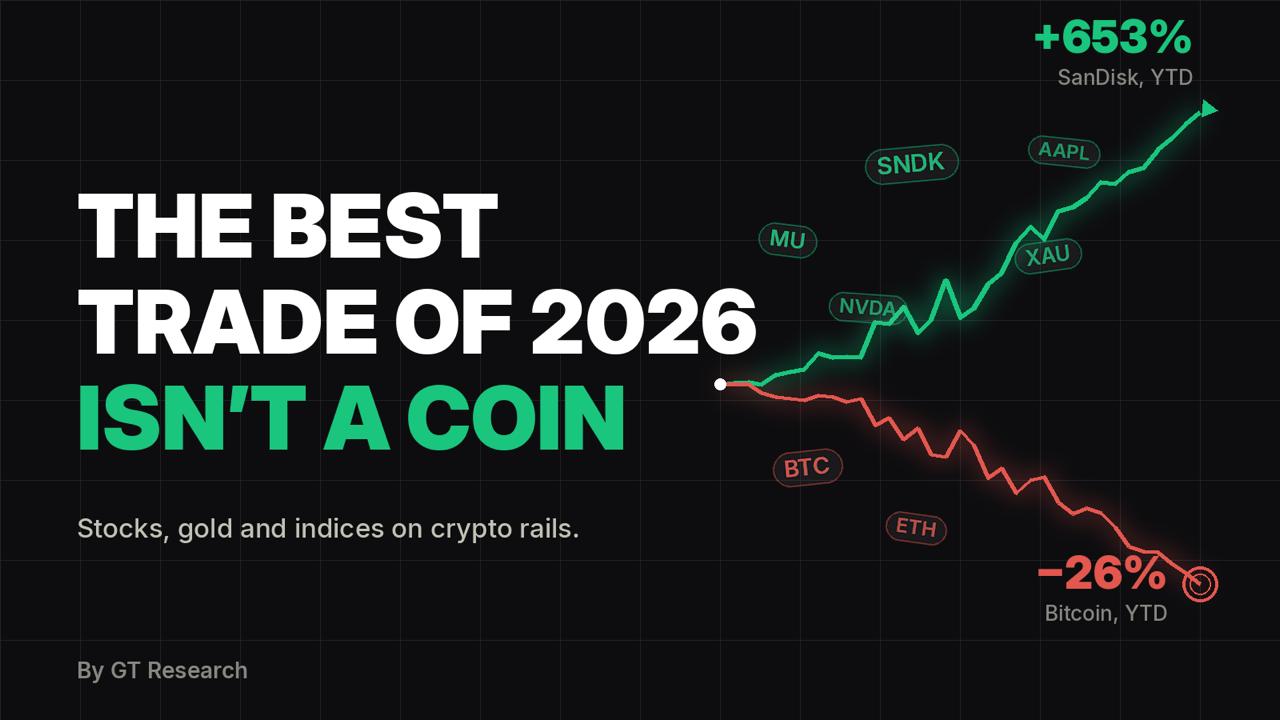
On August 14, the S&P 500 closed at a record high for the twenty-seventh time this year. That same week, Bitcoin traded under $65,000 — down 26% since January and nearly half off its October 2025 peak. For the first time since crypto became a real asset class, the bull market is happening somewhere else.
Ethereum tells the same story, only louder: down 35% year to date, more than 60% below last August’s high. Meanwhile the index kept grinding out records. That’s a gap of roughly forty percentage points in eight months, between two markets that most traders still watch on the same screen.
A 40-point gap, not a breakup
Here’s the part that gets misread. Crypto hasn’t decoupled from stocks — the 30-day correlation between Bitcoin and the S&P has held between 0.5 and 0.74 all year. The two markets still move together day to day. What changed is the drift: same waves, opposite tide. Over one 90-day stretch this summer, Bitcoin lost about 21% while the S&P added almost 5%.
And by crypto standards, this bear is strangely polite. A 49% drawdown from the top sounds brutal until you remember previous cycles routinely erased 75–80%. Sentiment gauges sit at neutral, not panic. This isn’t capitulation. It’s boredom — the marginal dollar simply found better action elsewhere.
Where the bull actually lives
Not where you’d guess. The lazy summary of 2026 is “the AI rally,” yet information technology is the worst sector in the S&P year to date. The violence is inside the sectors: within losing tech, a narrow memory-and-storage group went vertical on the HBM and NAND supply squeeze. Put the year on one ladder and it looks like this:
| 2026 so far | Return YTD |
|---|---|
| SanDisk | +653% |
| Micron | +255% |
| Western Digital | +211% |
| Energy sector (S&P 500) | +35% |
| Healthcare sector | +22% |
| S&P 500 | +13% |
| Information technology sector | −7.5% |
| Bitcoin | −26% |
| Ethereum | −35% |
One aisle of one sector produced the best trades of the year while the sector itself bled. Meanwhile the rally is broad — the equal-weight S&P is beating the cap-weighted one — so this isn’t seven famous tickers carrying the index either.
That combination — a rising market with savage single-name dispersion — is a stock picker’s market. Buying “tech” got you nothing. Buying the right memory name tripled your money. Sector labels stopped being useful; timing and selection started paying.
Even crypto companies trade like stocks now
The cleanest evidence of where the market’s head is at comes from crypto-linked equities, and it splits exactly along the income statement:
| Company | Makes money from | YTD 2026 |
|---|---|---|
| IREN | AI compute contracts (ex-miner) | +221% |
| TeraWulf | AI compute contracts (ex-miner) | +73% |
| Circle | stablecoin reserves | −47% |
| Coinbase | crypto trading fees | −52% |
| Strategy | BTC on the balance sheet | −65% |
Miners that pivoted to renting out compute for AI rallied with stocks — the industry signed north of $70 billion in AI-compute contracts this year. Companies whose revenue rides on crypto prices sank with crypto; Strategy sits on more than 840,000 BTC bought near $75,000 average, with purchases paused since June. Same exchanges, same currency, same rates — the market is no longer paying for crypto exposure, it’s paying for hardware revenue.
Traders can argue with that verdict or trade it. The second option pays better.
Everything became tradeable on crypto rails
Exchanges saw where the volume wanted to go and listed the bull market itself. Gold perpetuals arrived in December as the first TradFi contract of the wave; Tesla followed in January as the first stock perp. Eight months later there are more than forty contracts covering nearly everything with a ticker:
- Megacaps — Apple, Microsoft, Amazon, Google, Meta, NVIDIA, Tesla
- Semis and memory — Micron, SanDisk, Intel, TSMC, AMD
- Indices — S&P 500, Nasdaq-100, Russell 2000 via ETF contracts
- Korea — Samsung, SK Hynix
- Commodities — gold, silver
- Pre-IPO — OpenAI, Anthropic, SpaceX
All of it margined in USDT, with no brokerage account and no closing bell. A crypto-native trader can now put on a Micron position at 3 a.m. on a Sunday, hedge it with an index short, and keep gold on the side — from the same balance that used to only touch BTC pairs.
The catch: timing eats returns
There is a tax on chasing, and this year it was collected in full. Roughly half of the new stock contracts trade below their debut price even with indexes at all-time highs — we published the full 43-contract table here. The reason is mundane: most contracts listed in May and June, right at the local peak of the AI trade. Korea’s KOSPI topped on June 22 and fell 38%; the memory group dipped into a technical bear market in July before recovering. The assets were fine. The entries weren’t.
So the honest read of 2026 is this: the bull run is real, it lives in TradFi, and it punishes exactly the habits crypto traders built during coin seasons — buy the new listing, hold the narrative, check the chart when you wake up. A market with 40-point spreads between winners and losers, trading around the clock across time zones, rewards rules over reflexes.
Which is the argument for not trading it by hand.
Same AI strategies, new markets
Everything above is tradeable on GT App today — tokenized stocks on spot, TradFi perpetual futures on gold, indices and the big tech names — under the same AI strategies GT users already run on crypto. Pick or build a strategy, backtest it, set your risk limits, and let the agents execute. They don’t chase listings, don’t sleep through the Asia session, and don’t get sentimental about a ticker.
The bull market changed address this year. Launch GT App and put the machines on the TradFi shift — including at 3 a.m. on a Sunday.
Market figures reflect prices as of August 18, 2026. Past performance is not a guide to future results.