
Bitcoin Tops $70K: What The August 19 Short Squeeze Taught Traders About Speed
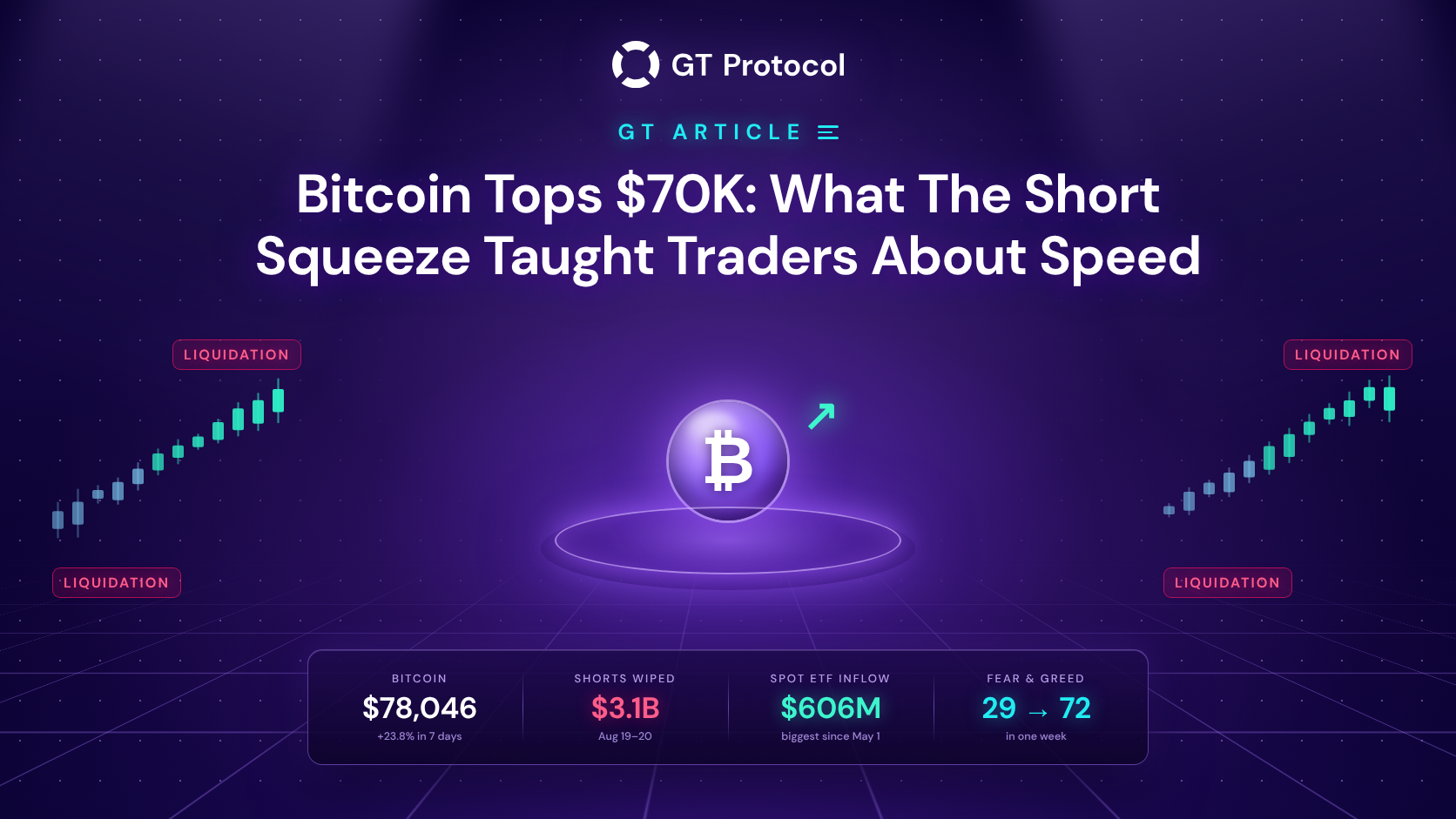
On August 19, 2026, Bitcoin ended a six-week chop between $62,000 and $66,000 in a single evening, gaining more than 11% in a day and clearing $70,000 for the first time since June 2. By August 21 it trades near $78,000, more than $3.1 billion in short positions have been liquidated across two sessions, and the Fear & Greed Index moved from 29 to 72 in a week. The real story is not the number. It is the speed, and what separated the traders who caught the move from the ones who did not was whether automation was running while they slept.
This article compares the two ways traders met that squeeze: checking charts by hand and running rules-based automation. It walks the dimensions that actually decided outcomes, and ends with what the industry is building this same week to close the gap.
What triggered the August 19 move
The primary driver was liquidity, not crypto. On August 19 the U.S. Treasury said it would at least double the size of its long-end bond buyback operations, from $2 billion to at least $4 billion per operation, covering the 10-to-20-year and 20-to-30-year sectors. Most desks read it as support for the $30-trillion-plus Treasury market. Bitcoin, equities, gold and long-dated bonds all rose together within hours. That is the tell of a macro flow move, not a crypto-native rally.
Regulation was the second leg. The day before, the SEC had proposed Regulation Crypto Assets, with a fundraising exemption of up to $75 million per 12-month period and a safe harbour that could pull certain tokens outside the legal definition of a security. On the 19th the White House hosted executives from Coinbase, Gemini, Kraken, Ripple and Robinhood alongside SEC chair Paul Atkins. Prices went vertical.
None of this is settled law yet. The buyback increase does not take effect until September 9. The SEC text is a proposal open to comment, not a rule. And the CLARITY Act faces a September 15 cloture vote that it is reported to be short of the 60 votes for — a vote on whether the Senate may begin debating the bill, not on passing it. Read the moves as flow-driven, not as a regulatory decision that has already happened. Update: that vote failed on September 15, 49 votes in favour to 50 against; what it did and did not change is covered separately.
Where the market stands, August 21
| Asset | Price | 24h | 7d |
|---|---|---|---|
| BTC | $78,046 | +8.4% | +23.8% |
| ETH | $2,405 | +4.9% | +27.8% |
| XRP | $1.39 | +20.4% | +38.8% |
| SOL | $91.79 | +4.7% | +21.7% |
| BNB | $678 | +5.4% | +11.5% |
| DOGE | $0.0839 | +9.2% | +19.8% |
| ADA | $0.2137 | +12.3% | +18.6% |
| HYPE | $74.59 | +1.1% | +32.1% |
Prices as of midday CET on August 21, 2026, from Binance spot feeds, with HYPE from Hyperliquid; figures move by the minute and will be stale by the time you read this. XRP led the week and reclaimed the $1 level it had spent weeks below. HYPE was already cooling — up around 1% on the day against 32% on the week — after the CFTC chair said publicly he was working on a path to bring Hyperliquid onshore. TRON, unusually, barely moved.
Why the squeeze was so violent
More than $3.1 billion in short positions were liquidated across August 19 and 20, the largest wave of short liquidations in CoinGlass records going back to 2021. August 19 carried most of it: of $2.99 billion in total liquidations that day, $2.74 billion came from shorts — 92% of the damage sat on one side of the book.
Much of the price action was mechanical. When a leveraged short is force-closed, the exchange has to buy the underlying to close the position, and that buying pushes price higher, which liquidates the next tier of shorts, and so on. It is a cascade. Cascades give some of the move back, because forced buyers are not conviction buyers. The one measurable source of real, non-forced demand this week was spot Bitcoin ETFs, which pulled in $606 million on August 20, the biggest day since May 1. Ethereum ETFs added $221 million. That inflow number is what separates a squeeze that fades from a squeeze that holds.
Manual reactive trading vs automated trading: the real comparison
The dimension that decided who caught the move was not skill. It was presence. Someone who opened a chart at 9 a.m. New York time on August 19, saw a sixth week of flat range, closed the tab and came back after dinner missed the entire vertical leg. The Treasury headline landed mid-morning, roughly $1.4 billion was liquidated within four hours, the White House event ran through the afternoon, HYPE jumped sharply in one session, and XRP moved from $1.00 to $1.34 in under two days. That is not a market you can trade by refreshing a browser tab. The table below compares what happens across the two approaches when a move like this arrives.
| Dimension | Manual reactive trading | Automated trading |
|---|---|---|
| Response time to a signal | Minutes to hours (if you see it) | Seconds after the condition triggers |
| Overnight and weekend coverage | You are asleep | Runs 24/7 on exchange APIs |
| Emotion during a cascade | FOMO on the way up, panic on the give-back | Rules do not feel |
| Position management on a live trade | You have to be at the screen | Trailing take-profit, stop-loss and safety orders update automatically |
| Handling of a squeeze reversal | Freeze: is it a top or a pullback? | Pre-defined exit; no debate at the moment of stress |
| Custody of funds | On the exchange | Also on the exchange; API keys, no withdrawal rights |
| Cost of being wrong | Full discretion, no defined limit | Sized by the stop and position set before the trade — though gaps, slippage and exchange outages can still overshoot it |
These are properties of the tools themselves, not a claim about results. Neither column is a promise: automation removes hesitation, it does not remove risk, and a bot follows a bad rule as faithfully as a good one. Exchange fees, funding rates and slippage during a squeeze apply to both approaches equally. The point is not that automation is smarter than a good discretionary trader. A good discretionary trader who happened to be at the screen with a plan had every chance to act on August 19. The point is that the number of hours in a week when you can be at the screen with a plan is small, and this week the move happened outside most of them.
What the industry shipped the same week
The response from the industry to this kind of speed problem was not another indicator. It was to hand execution to software with rules. Binance launched Agent OS on August 20, a developer platform that lets AI agents call exchange functions inside user-controlled permission boundaries, with agents running in dedicated sub-accounts and withdrawals blocked by default. The same week, the CFTC put artificial intelligence on the agenda of its first Innovation Advisory Committee meeting. Two independent moves in the same week, from a large exchange and a U.S. regulator, both pointing at the same idea: humans set the boundaries, software runs inside them.
GT Protocol has been building that for three years. GT App connects to a Binance or Hyperliquid account through an exchange API key configured with trading permissions only, no withdrawal rights. Bots run on that account around the clock, funds stay on the exchange in the user’s own account, and the main private key is never requested. Inside that boundary, the platform runs DCA and futures bots with trailing take-profit, mandatory stop-loss, safety-order ladders and a feature called Trend Changer that reacts to a KDJ cross against the bot’s direction. On Hyperliquid, the vault mode recalculates open positions and updates take-profit parameters automatically when depositors withdraw, so the strategy does not silently break when the balance changes.
Before any of that runs live, GT AI Backtest covers the other half of the problem. Pick a ready-made strategy or design your own, test it on real historical data with parameters matched one-to-one to how a live bot would execute, then launch in one click on Binance or Hyperliquid. No deposit is at risk during testing, and a backtest describes how a rule behaved on history, which is not a forecast of how it will behave next week.
The AI Hedge Fund: no human in the loop
The most direct answer to “can software actually trade this?” is the GT AI Hedge Fund, a public showcase where eight frontier AI models — Claude, GPT, Gemini, DeepSeek, Grok, Qwen, Kimi and GLM — each run their own book across crypto and stocks, deciding every six hours with no portfolio manager and no human at the desk. The models see the market, arm the bots, set the stops, and their reasoning is published live. Every deal, every position and every decision behind them is verifiable on the site. The paper arena is the full read of what each model is doing right now.
A separate real-money Hyperliquid vault has been live since June 2026, running four model slots in one book — DeepSeek and Gemini on crypto, Claude and DeepSeek on the S&P 500 and gold. It is an open experiment rather than an investment product: every closed trade is verifiable on the Hyperliquid explorer, and the value of a deposit can fall as easily as it can rise.
The showcase is not there to pick the best model. It is there to demonstrate the GT toolset (signals, Trend Changer, safety orders, Smart Exit, trailing take-profit) being wielded by agents that never sleep. That is the same toolset available to any user of GT App.
Frequently Asked Questions
What caused Bitcoin to jump above $70,000 on August 19?
The primary trigger was the U.S. Treasury saying it would at least double its long-end bond buyback operations, from $2 billion to at least $4 billion per operation, which markets read as liquidity support. Bitcoin, equities, gold and long bonds all rose together. A White House meeting with crypto executives, held the day after the SEC proposed its Regulation Crypto Assets package, added fuel.
How large was the short squeeze?
More than $3.1 billion in short positions were liquidated across August 19 and 20, per CoinGlass. On August 19 alone, $2.74 billion of the day’s $2.99 billion in total liquidations came from shorts. It is the largest wave of short liquidations in records going back to 2021.
Is the rally sustainable?
Nobody can tell you that in advance. Part of the move was mechanical short-covering, which typically gives some ground back. The measurable source of non-forced demand is spot ETF inflows: $606 million into Bitcoin ETFs on August 20 and $221 million into Ethereum ETFs the same day. Whether it holds depends more on whether those flows continue than on the size of the initial squeeze.
Is the CLARITY Act now law?
No. The CLARITY Act is heading to a September 15 cloture vote and is reported to be short of the 60 Senate votes needed. That vote decides only whether the Senate may begin debating the bill. Nothing announced this week is a regulatory decision yet. Update: the September 15 motion fell short, 49 votes in favour to 50 against, according to CoinDesk; see our note on the CLARITY Act vote.
How is automated trading different from copy trading?
Copy trading mirrors another trader’s positions. Automated trading executes a defined rule set (a signal, an entry, a stop-loss, a take-profit and a position size) without a human in the loop. On GT App the rules are the user’s own, and the exchange API key carries no withdrawal permission, so funds stay under the user’s control.
Can automation react to fast news events like the August 19 move?
Automation reacts to prices, not to headlines. When a Treasury announcement pushes a price through a level, a rules-based bot responds to the price break within seconds. It will not read the article and form an opinion. That is the trader’s job, before the move, when the rules are set.
What is the difference between the AI Hedge Fund paper arena and the real-money vault?
The paper arena runs eight models on paper books across crypto and stocks. The real-money vault runs four model slots — DeepSeek and Gemini on crypto, Claude and DeepSeek on the S&P 500 and gold — on a live Hyperliquid vault, with every closed trade verifiable on-chain and the models publishing their reasoning every six hours. Both use the same GT toolset.
The takeaway
The August 19 squeeze was not a lesson about Bitcoin’s fair value. It was a lesson about the difference between markets that give you time and markets that do not. When the next move comes, up or down, the traders who were already inside the trade will not have been faster thinkers. They will have been the ones who set the rules the day before and let the rules run. Set your rules on GT App and test them on real market history before a single dollar is at risk.
A month later the same market delivered its next scheduled test, a quarterly options expiry with about $15.8 billion settling and the price about $10,000 above max pain; how we size a bot for that week is in Bitcoin Options Expiry: Does Max Pain Really Move the Price?.
Not financial advice, and nothing here is a prediction or a promise of returns. Prices are as of August 21, 2026 and may be stale by the time you read this. Leveraged trading carries risk of total loss.