
Grid Trading Bots: Spot vs Futures Explained
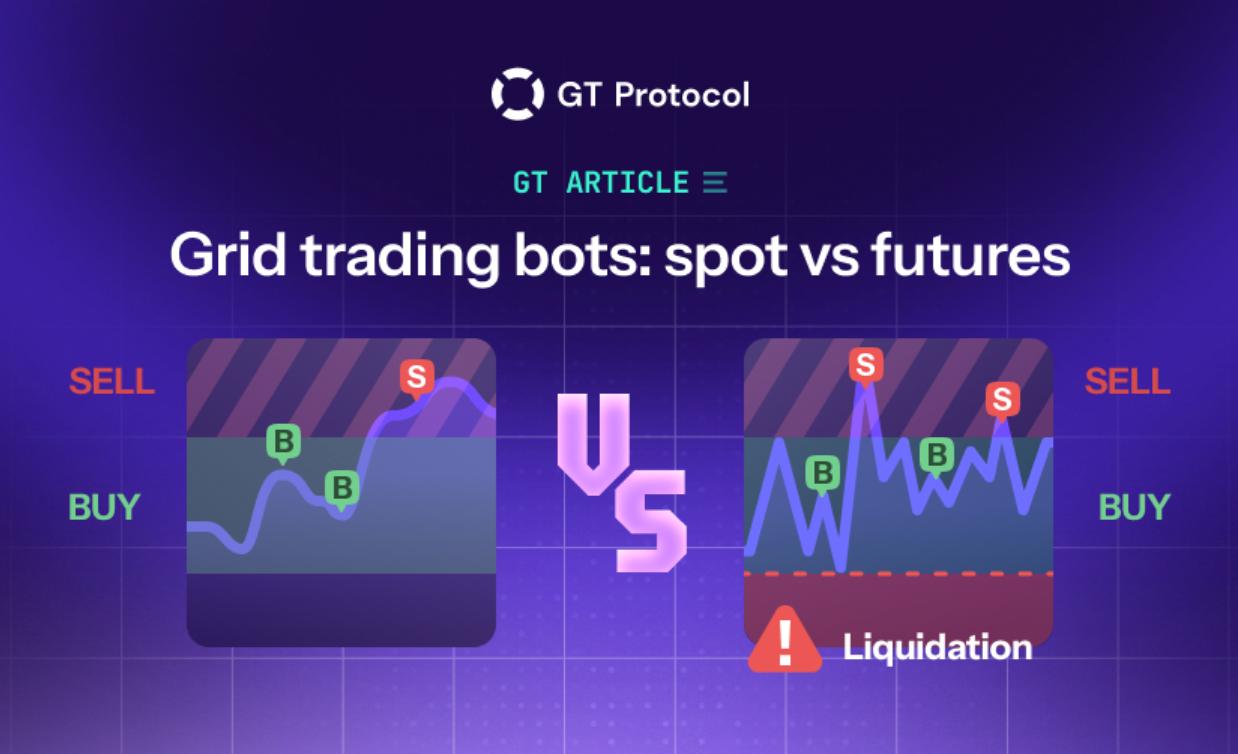
A grid trading bot places a ladder of buy and sell orders at fixed intervals around a price and profits from every round trip inside that ladder. Spot grids use only capital you already hold, have no liquidation, and suit sideways markets. Futures grids add leverage and can trade both directions, but a wrong-way move outside the grid can liquidate the position. Pick spot for range-bound assets you would hold anyway; pick futures when you want capital efficiency and can respect a stop.
This is the practical version of the debate — mechanics, when each fits, how volatility should change your grid spacing, the pitfalls that eat most grids, and how to set one up inside the GT App. GT runs grids on both Binance and Hyperliquid, so the venue choice matters and we cover that too.
Table of contents
- How a grid trading bot actually works
- Spot grid bots: mechanics and fit
- Futures grid bots: leverage and liquidation
- Side-by-side comparison
- How volatility should set your grid spacing
- On-chain grids: Hyperliquid vs a CEX
- Common pitfalls
- Setting up a grid in GT App
- FAQ
How a grid trading bot actually works
A grid trading bot is an automated strategy that divides a price range into equal steps and places alternating buy and sell orders at each step. When a buy order fills, the bot immediately posts a sell order one step higher; when that sell fills, it posts a buy one step lower. The bot keeps recycling those fills as long as price oscillates inside the range. Every completed round trip locks in the step size minus fees, regardless of the wider trend. Grids do not predict direction — they harvest volatility. That is why they work in choppy, mean-reverting markets and struggle in strong trends that walk price out of the range and leave the bot holding inventory it cannot sell for a profit.
The three parameters that define a grid are the upper bound, the lower bound, and the number of grid lines between them. Everything else — position size per line, whether the bot takes the long side or both sides, whether it uses leverage — sits on top of those three numbers.
Spot grid bots: mechanics and fit
A spot grid bot buys and sells the actual asset using capital you already hold in the exchange wallet. There is no borrowing, no liquidation, no funding to pay. If the price crashes through the lower bound, the bot stops buying and you are left holding the asset — a loss on paper, but not a forced close. Spot grids fit assets you are comfortable owning long-term, in ranges that reflect real support and resistance rather than short-term noise. Common fits: blue-chip crypto (BTC, ETH) during consolidation phases, stablecoin pairs, and high-cap altcoins after a trend has cooled. The trade-off is capital efficiency — every grid line requires the full notional in your account, so a 20-line grid on BTC needs meaningful cash to matter.
Spot grids also give you a clean fallback: if the market breaks out of the range upward, you still hold the base asset and can pause the bot, sell manually, or restart with wider bands. The worst realistic outcome is that you own an asset at a lower blended cost than a buy-and-hold entry.
Futures grid bots: leverage and liquidation
A futures grid bot trades perpetual contracts on margin, which changes three things at once. First, capital efficiency jumps: a 5x leveraged grid needs one-fifth the collateral of the equivalent spot grid, freeing capital for other strategies. Second, the bot can run a neutral or short-biased grid — it can sell first and buy back lower, which spot cannot. Third, and most important, the position can be liquidated. If price walks against the grid far enough and the accumulated inventory pushes the position below maintenance margin, the exchange force-closes at a loss that can wipe the isolated collateral. Funding rates add a second cost: on Binance and Hyperliquid, longs pay shorts (or vice versa) every few hours depending on the funding sign, and a grid that leans one way accumulates funding drag over time.
Futures grids fit traders who want capital efficiency, are comfortable sizing a hard stop-loss outside the grid, and check funding before selecting the direction bias.
Side-by-side comparison
| Dimension | Spot grid | Futures grid |
|---|---|---|
| Collateral required | Full notional per grid line | Notional divided by leverage |
| Liquidation risk | None — you hold the asset | Yes, if price exits the grid against the bias |
| Direction | Long-only in practice | Long, short, or neutral |
| Funding cost | None | Paid or received every ~8h depending on sign |
| Worst-case outcome | Holding the asset below cost | Isolated collateral liquidated |
| Best-fit market | Sideways range on assets you accept holding | Sideways range with tight risk control |
| Capital efficiency | Low | High |
| Operational complexity | Low — set and forget | Higher — watch funding, margin, stop |
Venue documentation for the mechanics behind these differences: Binance Futures funding rates and the Hyperliquid funding docs. Both change fees and tiers over time — check before sizing a bot.
How volatility should set your grid spacing
Grid spacing is the single parameter that separates a working grid from a dead one. Space the lines too tight and fees eat every fill before the round trip clears; space them too wide and price crosses only one or two lines a day, which is not enough activity to compound. The right spacing scales with the asset’s short-term volatility. A rough rule: set the step size to roughly 30–60% of the asset’s average 1-hour candle range in the timeframe you plan to run. Bitcoin in a quiet week may want 0.3% steps; a mid-cap alt in a lively week may want 1.5%. The number of lines then follows from the range you pick — 20 to 40 lines is a common comfortable band. If you cannot decide, start with fewer, wider lines: you can always add density later once you see the fill rate.
The other input is range width. Set the upper and lower bounds to a level of support and resistance you actually believe in, not a symmetrical box around the current price. Grids die when their range was drawn on hope.
On-chain grids: Hyperliquid vs a CEX
Running a grid on Hyperliquid instead of Binance changes the trust model and a few operational details, not the strategy itself. Hyperliquid is an on-chain perpetuals DEX with an order book that runs fast enough for automated strategies, and it is a first-class venue in the GT App — most rival bot platforms do not support it. Because it is non-custodial, your collateral stays in a wallet you control; the bot signs orders on your behalf but cannot withdraw funds. Onboarding uses GT Magic, the Telegram-native flow that connects your wallet with one signature, keeping your keys with you. Funding rates settle hourly on Hyperliquid rather than every eight hours on Binance futures, which matters for grids that lean directional — the cost accrues more granularly.
The trade-off: on-chain perps have thinner books than Binance on the long tail of alts, so a wide-line grid on a mid-cap may see partial fills. For BTC, ETH, SOL and other majors the depth is fine.
Common pitfalls that kill grids
- Range set to hope, not structure. Drawing bands around the current price and calling it a range is the fastest way to lose. Bands need to sit at prior swing highs and lows.
- No stop outside the grid. On futures especially, a grid without a hard stop is a slow liquidation. Set one below the lower band and accept the exit if it hits.
- Steps too tight for fees. A 0.05% step on a venue with 0.04% taker fees earns almost nothing per trip. Model the fee round-trip before launching.
- Running a neutral grid through a trend. Grids assume mean reversion. Turn them off (or switch to a directional strategy) when volatility regime changes.
- Ignoring funding on futures. A short-biased grid on a coin with persistently positive funding pays every eight hours. Over a month that is a real number.
- Over-leveraging to squeeze capital efficiency. 10x on a grid narrows the liquidation buffer to a rounding error. Keep leverage low — 2x to 3x is plenty for most grids.
Setting up a grid inside the GT App
Inside the GT App, grids live in the strategy library alongside DCA and Trend Changer. You pick the exchange (Binance or Hyperliquid), the trading pair, the upper and lower bounds, the number of lines, and the size per line. For futures grids you also set leverage and a stop. The AI Hedge Fund agents use these same primitives when they run automated positions, which is why we keep the parameter surface deliberately small: three range numbers, one size, one stop.
Before launching real capital, run the configuration through GT AI Backtest — the historical replay covers Binance and Hyperliquid candles and will tell you how the grid you drew would have behaved through the last few volatility regimes. If the backtest shows fewer than a handful of round trips per week, widen the bands or pick a livelier pair. For futures strategies that build-test-launch loop is now a single screen in the GT App: the rules you backtest are the rules the bot runs.
Frequently Asked Questions
What is a grid trading bot?
A grid trading bot is an automated strategy that places buy and sell orders at fixed price intervals inside a chosen range and profits from every round-trip fill. It harvests volatility rather than predicting direction, which is why it works best in sideways markets.
Are spot grids safer than futures grids?
Yes in the sense that spot grids cannot be liquidated. The worst realistic outcome is holding the asset below your average entry. Futures grids offer higher capital efficiency and short-side exposure but carry liquidation and funding risk.
What is the best asset for a grid bot?
Range-bound assets with decent short-term volatility and enough liquidity to fill orders at each grid line. BTC and ETH work well during consolidation phases; high-cap alts work when a trend has cooled. Trending assets are a poor fit. Tokenized stocks pass the same test: the Magnificent Seven now trade on spot around the clock, and large-cap names spend much of the stretch between earnings inside a range — with the grid still working through the hours a brokerage account is closed.
How wide should my grid spacing be?
A working starting point is 30–60% of the asset’s average 1-hour candle range. Tighten only if you see round-trip profit clearing fees comfortably; widen if the bot is barely filling.
Can I run a grid bot on Hyperliquid?
Yes. Hyperliquid is a first-class venue in the GT App, with non-custodial onboarding through GT Magic — one wallet signature keeps your keys under your control while the bot signs orders on your behalf.
What kills a grid bot most often?
A price breakout that leaves the bot holding inventory outside its range, especially on futures without a hard stop. Second most common: fees eating tight-step grids, and funding drag on directional futures grids.
Do I need to watch a grid bot after launch?
Less than a directional strategy, but not zero. Check weekly that the range still reflects real support and resistance, and that the volatility regime has not shifted from mean-reversion to trend. If it has, pause and rebuild.
Where to start
Grids are one of the calmer ways to put automation to work: they do not need forecasts, and their failure modes are well-understood once you respect the range. Open the strategy library in the GT App, pick spot if you want simplicity and are happy holding the asset, futures if you want capital efficiency and can respect a stop. Backtest the configuration first, then launch small and widen once you have seen it fill through a full cycle.