
16 AI Agents, 13 Humans, $55K Saved: How We Rebuilt GT Protocol
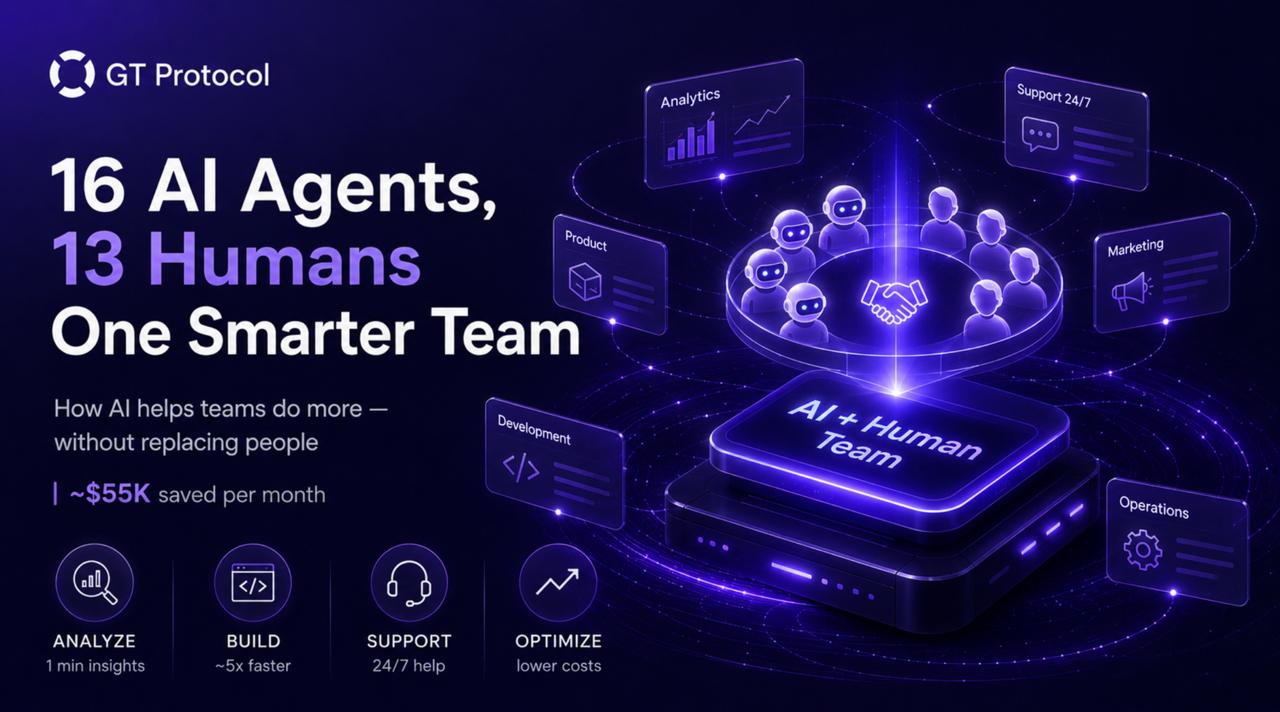
GT Protocol now runs on three operating layers: 16 functions handled entirely by AI agents, 4 functions run as AI-plus-human pairs, and 13 roles that stay fully human. Estimated operating cost dropped from a market-rate range of roughly $54,000–$75,000 per month for an equivalent team to about $9,350 per month for the current setup — a saving of around $55,000 monthly. The GT trading platform and every content, analytics, and support surface around it are the working proof of the model.
This is not a story about layoffs. GT Protocol was already a small team. The question we set out to answer was different: with today’s models, how much of a company’s routine work can move to agents so that a lean group of people can operate at the scale of a much larger organization? The answer, in our case, was roughly two thirds of the operational roster.
One caveat before the numbers: the $54,000–$75,000 baseline is built from average market salary ranges for remote IT, digital, and operations specialists across the CIS region, not from GT Protocol’s actual historical payroll. It is the cost we would have paid to reproduce the same 16 agentic functions with people, at market rates, at the time of writing.
How is GT Protocol structured around AI agents?
GT Protocol is structured in three layers. Sixteen operational functions — analytics, social media, design, research, first-line support, project management, content, moderation, reporting, and others — run fully on AI agents that execute on schedules or on triggers, without a person in the loop for each task. Four functions run as AI-plus-human pairs: backend engineering, DevOps, QA, and recruiting. Thirteen roles remain fully human: leadership, strategy, finance, legal, high-stakes negotiations, partnerships, community, and any decision that carries reputational or financial responsibility the company is not willing to delegate. The split is intentional. Agents handle repetition and speed. Humans set direction, own outcomes, and make calls that require judgement, context, or trust.
Why split it this way
The rule we used to sort each function was simple. If the work is high-volume, well-defined, and reversible when it goes wrong, it moves to an agent. If it is low-volume, ambiguous, or hard to undo, it stays with a person. Recruiting sits in the middle because sourcing is repetitive but the decision to hire is not — the agent screens, the human decides.
What do the 16 AI-only functions do?
The 16 agent-run functions cover the operational backbone of the company. They include content production and publishing, social distribution across Telegram and X, first-line support and community moderation, analytics and reporting, market and competitor research, project tracking, design of routine visual assets, and the trading research surface itself — the AI Hedge Fund, where eight large language models run capital autonomously under a deterministic manager. Each function runs on a fixed schedule or a trigger, produces an artefact, and either publishes it directly or drops it into a human approval queue. Nothing here is a demo. Every one of these agents ships work to production surfaces on a daily or hourly cadence.
The content and social pipeline
A dedicated content agent takes a one-line brief from a manager and returns a publication-ready article — structured, source-cited, image-attached, and pushed to the live site after a single human approval tap. A separate distribution agent posts on a set weekly rhythm across the company’s channels, drawing content from six rubrics that pull real numbers from the platform, the trading fund, and the help centre. Neither agent has editorial authority. Both have publishing authority once a human clicks approve.
The trading research surface
The AI Hedge Fund runs eight models — including Claude, GPT, Gemini, DeepSeek, Grok, Qwen, Kimi, and GLM — trading live on GT infrastructure. A separate deterministic capital manager, built without any language model inside it, allocates weight between them based on their live decision-and-outcome ledger. The output is a public research surface that doubles as a stress test for the platform itself.
Analytics, support, and moderation
Analytics that used to take a working day to produce now arrive in about a minute. A stats agent generates the daily company report at a fixed morning hour, answers ad-hoc questions from the team chat on mention, and never sleeps. Community moderation runs the same way — pattern-matched, logged, reversible, and continuous. First-line support handles the recurring questions before a human is paged.
What do the 4 AI-plus-human functions do?
Four functions run as pairs: backend engineering, DevOps, QA, and recruiting. In each case the agent handles the volume and the human handles the judgement. In engineering, the agent drafts implementations, writes tests, and prepares deployments; a human engineer reviews the diff, decides what merges, and signs off on anything that touches production data or user funds. In DevOps, the agent monitors, alerts, and executes standard runbooks; the human handles anything that needs a decision the runbook does not cover. In QA, the agent generates and runs the test matrix; a human validates edge cases and release readiness. In recruiting, the agent sources, screens, and schedules; the human interviews and hires.
What changed in release speed
The measurable effect of pairing engineering with agents is throughput. Releases that used to take a full cycle now ship roughly five times faster on the same headcount, because the volume work — boilerplate, test scaffolding, deployment scripting, changelog drafting — moves off the human. The engineer’s day gets rebuilt around review and design decisions instead of typing.
What do the 13 human-led roles do?
Thirteen roles remain fully human, and this is deliberate. They cover leadership, strategy, finance, legal, high-stakes negotiations, partnerships, key account relationships, community leadership, and any decision that carries reputational, financial, or regulatory weight the company is not willing to delegate. These are the roles that require context an agent does not have — history with a partner, a read on a room, a fiduciary responsibility, a legal signature, a strategic bet that will only pay off in twelve months. An agent can prepare the brief for any of these roles. It cannot make the call.
Why some work will not be automated
The line we drew is not about capability. It is about accountability. When a decision goes wrong, someone has to own the outcome, learn from it, and change how the company operates next time. That loop is what a company is. Delegating it to an agent removes the mechanism by which the company gets better.
What did the restructure change in day-to-day operations?
The concrete changes are in speed, coverage, and cost. Analytics arrives in about one minute instead of one day, so decisions that used to wait for a report now happen in the meeting. Releases ship roughly five times faster on the same engineering headcount, because the boilerplate is off the humans. Support and moderation run 24 hours a day, seven days a week, without a rotation. The AI Hedge Fund runs a live research pipeline across eight models that no small team could staff around the clock. Content and social distribution ship on a fixed calendar without a marketing coordinator manually queueing every post. Overall, the operating cost of the layer that agents cover dropped from an estimated $54,000–$75,000 per month to about $9,350 per month.
What the $9,350 covers
The monthly figure is the direct cost of running the agents themselves: model API calls across the 16 functions, dedicated compute for the hedge fund and the automation servers, and the third-party services those agents depend on. It does not include the salaries of the 13 humans, which are accounted for separately. It is the substitution cost, not the total cost.
Frequently Asked Questions
Did anyone lose their job in this restructure?
No. GT Protocol was already a small team when this work started. The 16 agentic functions replaced work that either had not been staffed yet or was already stretching a small headcount thin. The point of the exercise was to let a lean team operate at the scale of a much larger one, not to reduce headcount.
How was the $54,000–$75,000 baseline calculated?
It is built from average market salary ranges for remote IT, digital, and operations specialists across the CIS region — the labour market GT Protocol would realistically hire from — applied to the 16 functions that now run on agents. It is not GT Protocol’s actual historical payroll and should not be read as one. It is the cost of reproducing the same operational output with people at market rates.
Which functions are fully run by AI agents?
The 16 fully agentic functions cover analytics, social media, design of routine assets, market and competitor research, first-line support, project tracking, content production, community moderation, reporting, and the live trading research surface. Each one runs on a schedule or a trigger and ships work to a production surface without a person in the loop per task.
Which functions still need a human?
Four functions run as AI-plus-human pairs — backend engineering, DevOps, QA, and recruiting — where the agent handles volume and the human owns the decision. Thirteen roles remain fully human: leadership, strategy, finance, legal, high-stakes negotiations, partnerships, key accounts, community leadership, and any decision that carries reputational, financial, or regulatory weight.
What happens if an AI agent makes a mistake?
Every agent writes to a reversible surface. Content lands in a review queue before publication. Social posts are drafted for approval, or, on the fully autonomous rubrics, they publish under a pre-agreed template and are visible immediately for correction. Trading agents run under a deterministic capital manager that can zero any model’s weight without touching the model itself. Support and moderation actions are logged and reversible. The design principle is that a failed agent action must be cheaper to undo than a failed human action.
Does this approach work for any company?
It works where the operational surface is digital, the volume of routine work is high, and the human roles that remain can clearly own outcomes. It is less applicable where the core product is a physical service or where every operational decision requires trained human judgement. The split we used — high-volume and reversible to agents, low-volume and consequential to humans — is portable, but the ratio is not.
What does the future look like from here?
The direction is not a company without people. It is a company where people set the direction and own the outcome, and agents carry the operational weight. As models get more capable, some functions that are hybrid today will move fully to agents. The 13 human-led roles are unlikely to change — the reasons they stay human are structural, not technical.
Conclusion
The 16-and-13 split is not a prediction. It is what GT Protocol runs on today. If you want to see what the agentic layer actually produces on the trading side, the live surface is app.gt-protocol.io for the platform and aifund.gt-protocol.io for the research fund. Both are running right now, with the same agents this article describes doing the work.