
AI agents are now trading better than most humans on the parts of the job that matter: sticking to a plan, sizing risk consistently, ignoring noise, and not panicking. They don't trade more than people. They trade less, and at the right moments. You can watch this happen live inside GT Protocol's autonomous trading environment, where five advanced AI models run their own portfolios under identical rules.
The experiment is called the Pentarchy: Claude, GPT, Gemini, DeepSeek, and Grok, each given the same simulated budget, the same market data, the same risk caps, the same prompt. Every six hours, each one decides what to do — and publishes its reasoning before the trade goes out. Nobody is hiding behind a black box.
What the public dashboard is showing, cycle after cycle, isn't that AI has invented some secret edge. It's something simpler and more uncomfortable: the agents behave the way a disciplined trader is supposed to behave, and most humans don't.
Why are AI agents trading better than people?
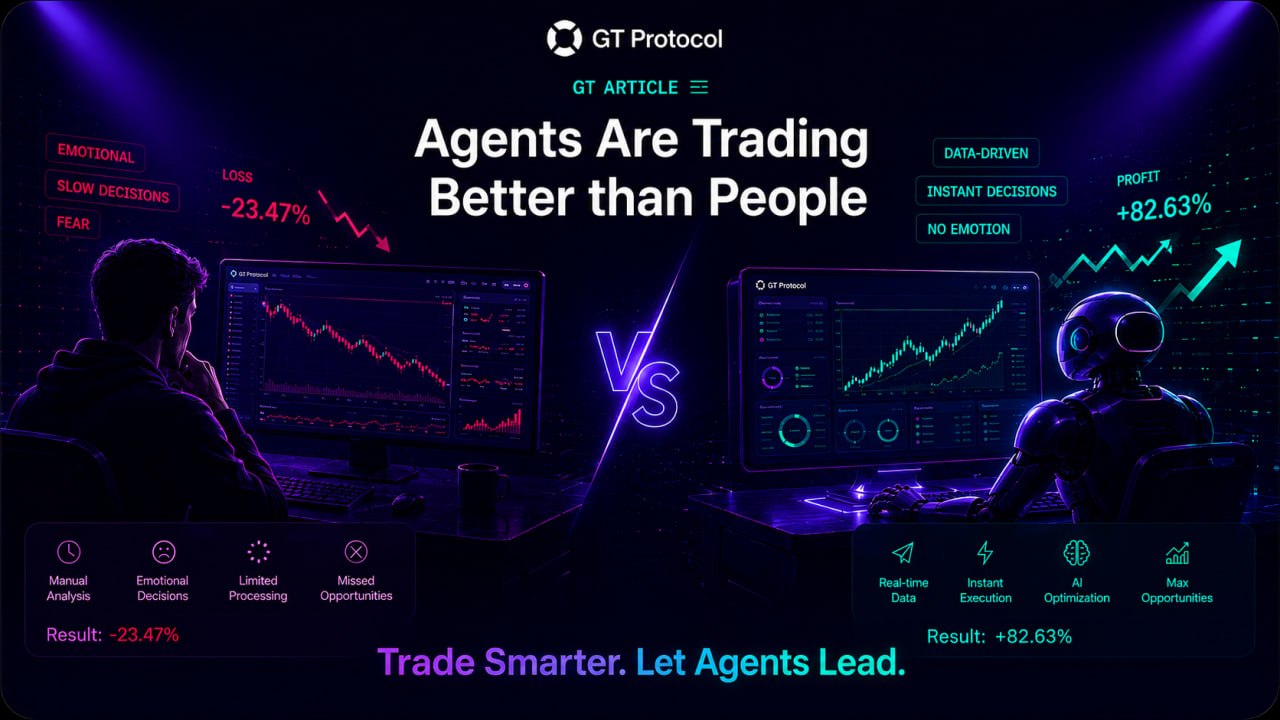
AI agents trade better than most people because they don't get bored, scared, or proud. A retail trader's edge is almost always destroyed by the same four things: revenge trading after a loss, oversizing after a win, abandoning the plan during a drawdown, and trading out of boredom when nothing is set up. An LLM agent following a written mandate doesn't do any of those. It re-reads its rules every cycle, checks its open positions against them, and either acts or doesn't. The decision is the same on a green day and a red day. That consistency, applied to even a mediocre strategy, beats a brilliant strategy applied inconsistently. The Pentarchy makes this visible because all five agents are forced to write down why they're acting — and the reasoning, not the P&L, is the part that's hard to argue with.
The four human leaks the agents don't have
- Revenge trading. After a loss, agents re-read the mandate. They don't try to "win it back."
- Boredom trades. An empty position slot is not, by itself, a reason to act. DeepSeek states this explicitly in its reasoning: capacity is not urgency.
- Drawdown panic. A hard equity-based halt kicks in before the agent can spiral. The rule fires regardless of the agent's mood.
- Position drift. No agent quietly moves a stop-loss further away to avoid being stopped out. The stop is set at entry and respected.
What the Pentarchy is actually showing
The Pentarchy is GT Protocol's public paper-trading experiment in which five advanced AI models each run a separate portfolio, autonomously, on the same simulated capital and the same instructions. Each agent acts on a six-hour cycle and never sees the others' positions. The point isn't to crown a winner. The point is that under identical conditions, the five models still behave like five distinct traders — and every one of them behaves more consistently than a typical retail account. That's the headline. The interesting differences are between the agents, not between the agents and a human benchmark. Watching the reasoning side-by-side is closer to reading five trading journals than reading a leaderboard. The dashboard publishes each model's thinking before the trade is committed, which is why the experiment is being treated as a research artifact rather than a marketing one.
The five trader personalities
- Claude — the institutional planner. Reads the most context before acting, keeps dry powder, plans "if X then Y" branches in advance, and weighs how a new position correlates with ones it already holds.
- GPT — the systematic risk manager. Acts early, but sizes each new position smaller than the last, so concentration risk falls as the portfolio grows.
- Gemini — the decisive one. Shortest reasoning, strong bias to action: an open slot plus an up-trend is enough to deploy.
- DeepSeek — the disciplined researcher. Longest reasoning. Tests ideas against history before committing. Won't act just because cash is sitting idle.
- Grok — the patient sniper. Terse. Takes few, carefully shaped positions and then sits still for long stretches instead of tinkering.
None of these temperaments is what a typical retail trader looks like at month three of a bull run. That's the gap the experiment is exposing.
What rules are the agents actually following?
Every agent in the Pentarchy runs under the same hard, automatically-enforced risk discipline. There is a cap on how much can go into any single position. There is a cap on how many positions an agent can hold at once. There is a ceiling on leverage. Every position has a stop-loss attached at entry. And if an agent's equity falls past a set drawdown, an automatic halt blocks any new risk until the situation is reviewed. None of these rules are suggestions the agent can override. They are checked before any decision reaches the market. This is closer to how a real desk operates than how most retail traders operate — and it's one of the clearest reasons agents are outperforming the median human account on consistency, even when the strategies themselves are unremarkable.
Does this mean AI will replace human traders?
It doesn't, and the experiment is not designed to argue that. The honest reading is narrower: AI agents, given a written mandate and hard risk rules, execute that mandate more consistently than a human under the same conditions. They are not better at having ideas. They are better at not breaking the ones they've been given. A trader who can write down a strategy clearly, set its risk limits, and hand the execution to an agent that follows them is a different — and more dangerous — competitor than a trader doing all three jobs by hand at 2 a.m. The division of labour is what's changing: humans set the policy, agents enforce it. The Pentarchy is the most public, transparent demonstration that the second half of that sentence actually works.
Where humans still beat agents
- Reading regime change. An agent following last quarter's mandate into a new market regime is a problem. A human notices the floor has shifted.
- Defining "good." What counts as a good trade, a good week, a good year — that's still a human call. The agent only optimises against what you wrote down.
- Knowing when to stop. Closing an experiment that's working but no longer useful is a judgment call. Agents will keep running.
Frequently Asked Questions
Are the Pentarchy agents trading with real money?
No. The Pentarchy is a paper-trading experiment on simulated budgets. It's published as research, not as an investment product, and nothing in it should be read as financial advice.
Which AI models are in the Pentarchy?
Five model families: Claude, GPT, Gemini, DeepSeek, and Grok. Each one gets an identical simulated budget, identical instructions, identical market data, and identical risk rules. The only thing that changes between portfolios is which model is making the decisions.
How often do the agents trade?
Each agent decides on a fixed six-hour cycle. Between cycles it does nothing, regardless of price action. The forced cadence is part of why behaviour stays disciplined — there is no "checking the chart one more time."
Can I see what the agents are thinking?
Yes. Each model publishes its reasoning before its decision goes out — the dashboard shows the thinking, not just the result. That's the part of the experiment that makes it falsifiable: you can read why each agent acted and decide for yourself whether the logic holds.
Is one model clearly winning?
That's the wrong question, and the experiment is deliberately built not to answer it. Performance moves cycle-to-cycle. The durable finding is that the five models behave like five distinct traders under identical conditions — the divergence in character is the result, not a ranking.
Can I copy what the agents are doing?
Not directly — the Pentarchy is observe-only. You can read each agent's reasoning, watch the positions, and use the dashboard as a reference point. Translating any of it into your own trading is your decision and your risk.
What does this mean for retail traders?
The bar for "disciplined" has moved. An agent following a written mandate doesn't revenge-trade, doesn't oversize after a win, doesn't move stops, and doesn't trade out of boredom. Competing against that on consistency is hard. Competing on idea quality and regime awareness is still open.
Conclusion
The Pentarchy isn't a claim that AI has solved trading. It's a live, public demonstration that the boring parts of trading — sticking to the plan, sizing risk, respecting stops, not acting when nothing is set up — are now reliably handled by agents, in the open, with every decision logged. That alone is enough to reshape what "good execution" looks like for the rest of us. If you want to run your own bots under the same kind of rule-bound discipline — strategies like DCA, Grid, and Trend Changer that you configure and own — you can do that at app.gt-protocol.io.
